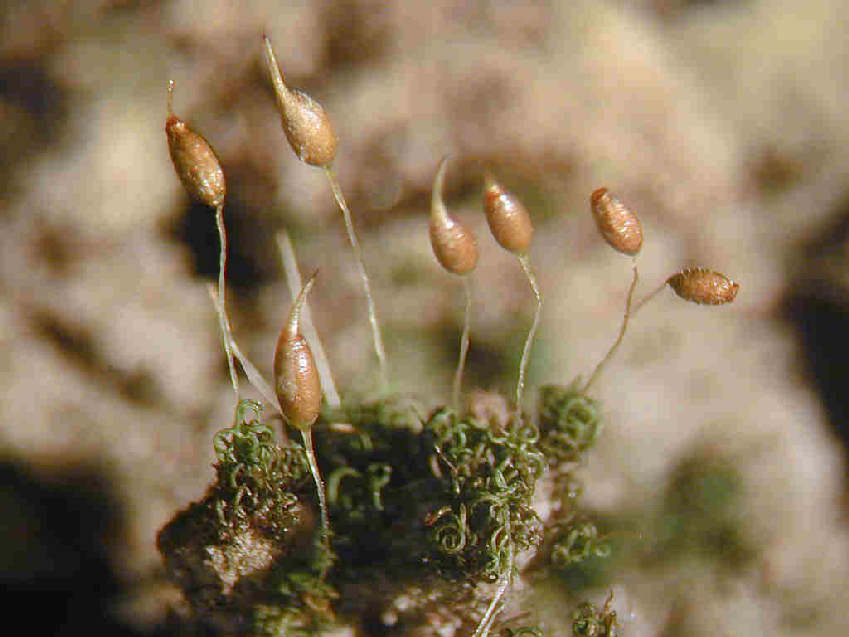
Photo
by Dr M Lueth ©.
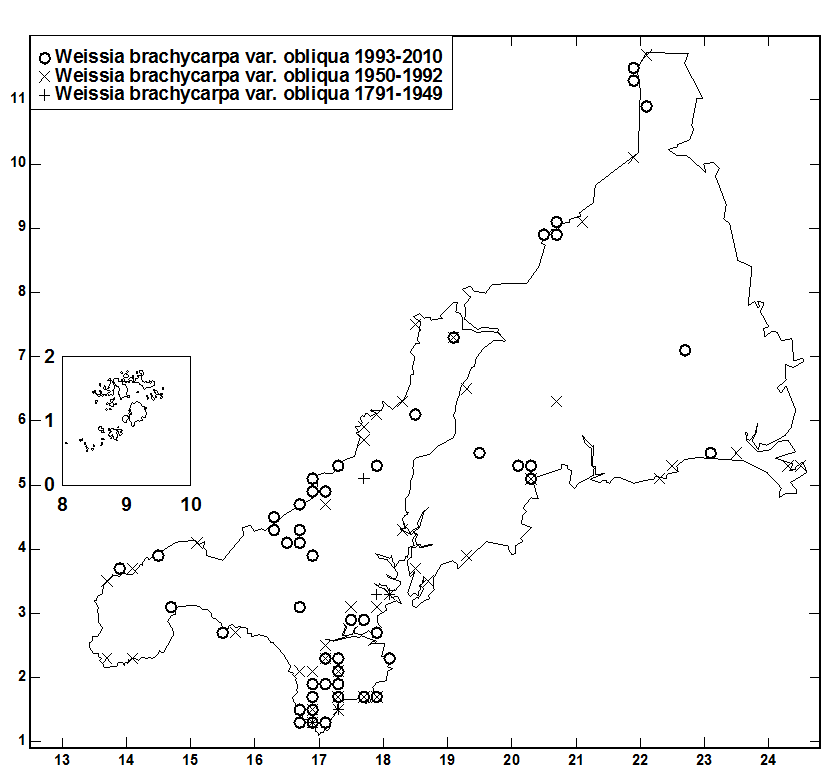
*1: Kynance Cove, 1912,
LJC (BM) (Paton 1969a: 728). [Earlier report
(St Michael's Mount, 1844, AG (PNZ), and in
Greenwood 1846) was based on an odd form of W. controversa, det.
EFW: Paton 1969a: 728].
*2: Earthy bank, Malpas
Road, Truro, Apr. 1960, JAP (BBSUK) (Warburg
1962: 370, Paton 1969a: 728).
Some patches of plants from vc1 have many capsules
that rupture to release spores as in W. squarrosa, but they
show no other characters of that species. Other plants have
capsules that dehisce in the usual manner through loss of the
lid, although top of capsule is then covered by pale membrane
through which spores escape by way of rounded hole in centre.
Somewhat under-recorded because mature capsules are
needed for reliable identification.
Grows as small tufts or low lawns. Habitat notes
from Cornwall are as follows. Mainly on mineral soil exposed
amongst turf on upper parts of sea-cliffs, cliff tops and
banks near the coast, over granitic and slaty rocks on the
north coast and serpentinite on the Lizard pen., perhaps
always on somewhat basic substrates and sometimes on soils
that include calcareous blown sand. Except on Lizard,
generally scarcer inland, with records from earthy banks e.g.
between pastures, graves (twice), a hedge-bank, soil in
crevices of 'hedges', soil among gravel on disused railway
track, soil in cemetery, soil over old mine-spoil (three
records), partly bare, dumped soil near china clay quarries
and arable field (once, in cereal stubble). Occurs in unshaded
or lightly shaded places, once partly shaded by deciduous
trees on creekside cliff. Two atypical records from peaty soil
on wet heathland over serpentinite on The Lizard, one of them
on side of hummock with Bryum
pseudotriquetrum. Often in pure patches; other associates
recorded are Bryum
capillare, Fissidens bryoides
var. bryoides,
Pleuridium
subulatum, Trichostomum
crispulum, Conocephalum conicum.
Unusual record in stubble field was with Bryum rubens, Dicranella staphylina,
Trichodon
cylindricus, Tortula
truncata.
Commonly c.fr. (only recorded when mature capsules
or mature spores examined): capsules immature 3-5; dehiscing
2-6, [7], [8]; dehisced 4, 5, 7, 8.
Unusual plants from near Holywell
(DTH 07-26) resemble this taxon, but spores
only 18-20 µm and
costa at leaf base rather wide (46-75 µm).