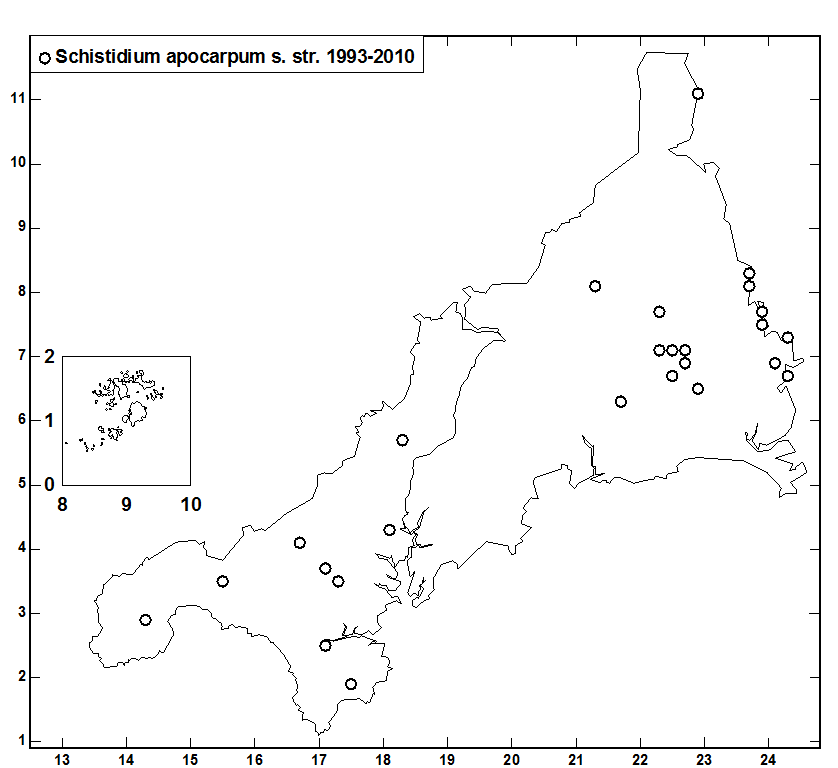
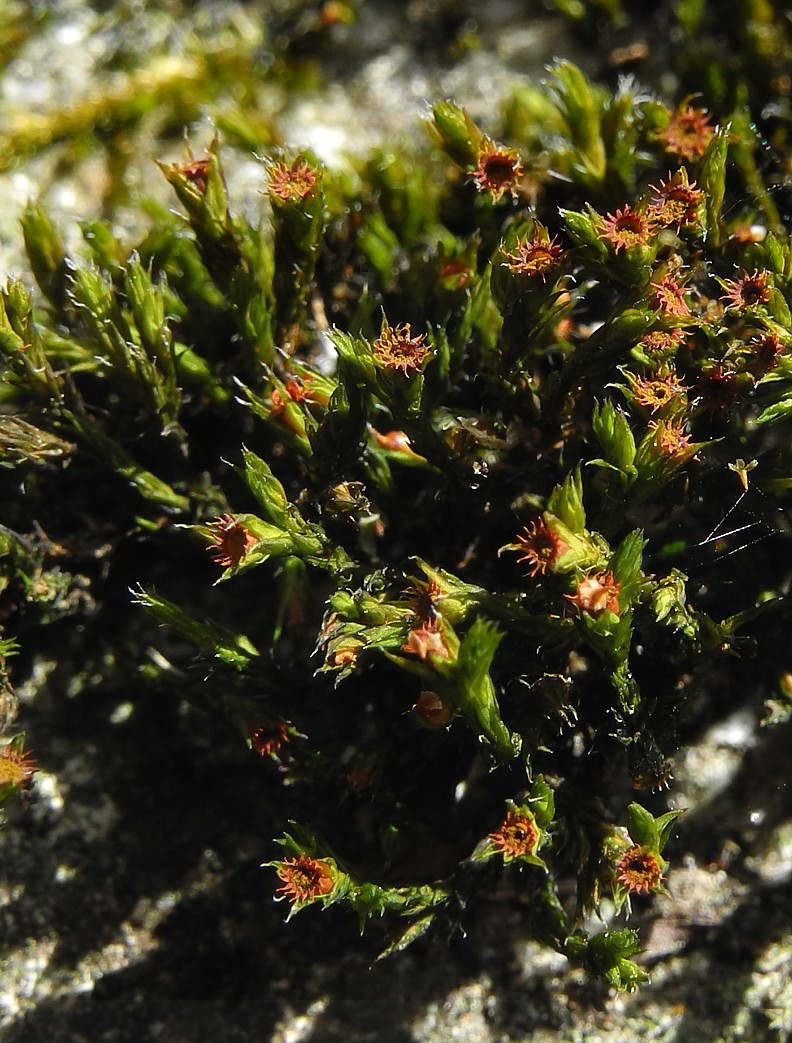
Photo
by Dr M Lueth
©.
*1: On stone, Kynance Cove,
Lizard, SW61, 1962, AJES, det. AJES (Rothero 2004b: 3).
*2: Silted, vertical
trunk of tree in flood-zone at edge of river, slightly shaded,
River Tamar, E. of Chilsworthy, SX47, 1998, DTH 98-40, det.
AJES (Rothero 2004b: 3).
Grows in tufts or small patches. Habitat
notes from Cornwall are as follows. Mainly restricted to hard
basic rocks and masonry in unshaded or partly shaded sites. InCornwall,
S. apocarpum s. str. may occur mainly
in more humid locations than many of those tolerated by the
commoner S. crassipilum. Several
of its records are from rocks in and beside streams and
rivers, including the flood-zone beside the R. Tamar, others
were of large populations on masonry on and below reservoir
dams and on concrete beside standing water. Mortared-stonework
low on church wall. On horizontal concrete at edge of water on
structure in china clay works, unshaded. On rocks
(serpentinite ?) emergent from large stream in deciduous
woodland, 0.3-0.6 m above water-level. On boulder (gabbro ?)
in short grassland at edge of heath. On unshaded granitic
blocks beside walls of ruined mine structures. Unusual record
of strong patch c.fr. on bark of exposed root of large old Ash
tree in slope in pasture. Several records from banks of R.
Tamar were on silted, vertical or steep bark of trunks of tree
in flood-zone at edge of river, slightly shaded (seen near to
Schistidium
rivulare). Also on unshaded slaty rocks in river flood
zone (with Schistidium
rivulare). Associates recorded include Bryum capillare, Didymodon rigidulus,
Grimmia pulvinata,
Tortula
muralis.
Plants confirmed as S. apocarpum s.str.: capsules
immature 1-3, 10, 11; dehiscing 2, 3; dehisced 2-5 [10, 11
old].