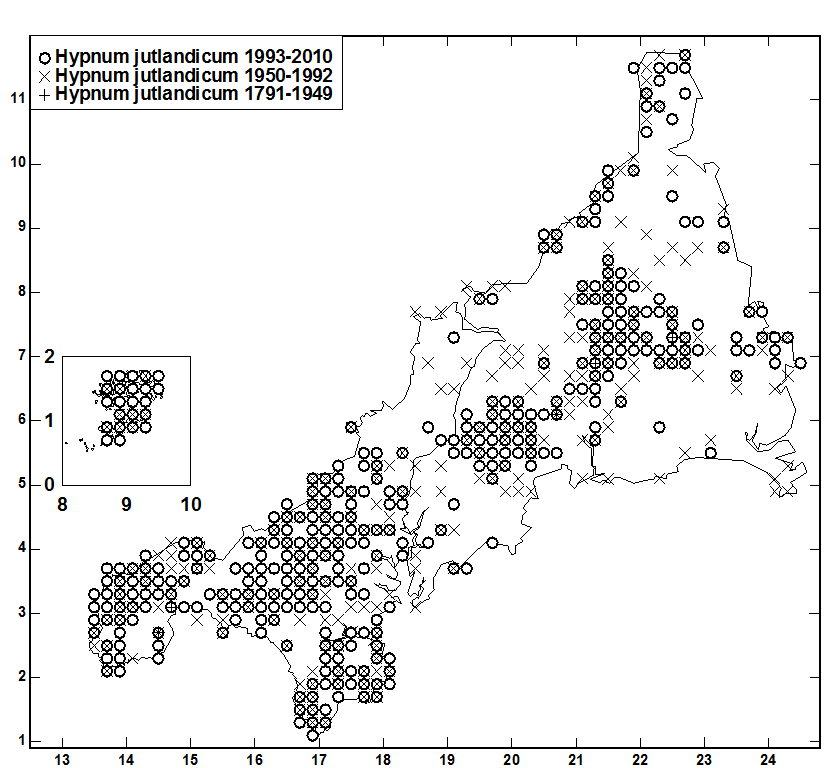
*1: Chyenhal Moor,
Newlyn, 1866, WC (OXF) (Paton 1969a:
755).
*2: Carclaze, St
Austell, 1962, JAP (BBSUK) (Paton 1969a:
755). ['Cardinham' (Tellam 1888) not supported by
specimen].
Stunted plants on tops of exposed sea-cliffs may be
hard to identify. Also occurs as form with erect stems on rock
above sea-cliffs.
Habitat notes from C&S are as follows. A very
common moss in heathland and acid grassland habitats,
sometimes abundant to dominant over large areas e.g. beneath
Calluna vulgaris.
On hummocks in mires and flushes (and sparsely amongst sphagna
on flat areas of some mires). In heaths and wet heaths,
especially in more or less open places.
On slopes of earthy mine spoil under Calluna vulgaris or
Gorse scrub. On heathy areas and under scrub or groves of
trees over old mine-spoil, unshaded to moderately shaded
(occasionally rather heavily shaded, e.g. on trackside bank in
deciduous woodland). Soil in gravelly woodland clearing
(unshaded to lightly shaded), on banks and in edges of conifer
and deciduous woodland and groves of trees. Soil on 'hedges',
heathy bank, about tors, occasionally on and near graves in
cemeteries. Heathy areas and slopes in old granite quarries,
and as often plentiful colonist of banks and flat ground
around working china clay quarries and their spoil heaps;
mainly occurs in later stages of vegetation succession to
heathland, but sparsely also as early colonist. At base of
heathy vegetation, in short turf and on soil on ledges or over
edges of rocks on slopes and tops of sea-cliffs (granitic,
slates, mica-schist granulite); on bank in old serpentinite
quarry above sea-cliffs, unshaded. Small amounts shaded under
trees in old quarries (Carboniferous slates). Extending onto
lower branches of Grey Willows in sheltered moist carr of Grey
Willow. One patch on low Grey Willow shrub in open carr, but
not on ground anywhere nearby.
Many associates recorded, commonly Hylocomium splendens, Pleurozium
schreberi,
Polytrichastrum formosum, Rhytidiadelphus
squarrosus,
Scapania compacta,
Pseudoscleropodium purum, Sphagnum spp., Thuidium
tamariscinum;
Calluna vulgaris,
Erica spp., Molinia
caerulea,
Potentilla erecta,
Pteridium aquilinum, Ulex gallii, Vaccinium
myrtillus.
Occasionally c.fr.: capsules immature 1, 2, 9-12;
dehiscing 1-3, [4], [9], 12; dehisced 1, 3-6. Sporophytes are
reported to be 'occasional' in most of British Isles (Smith
2006); in Cornwall they are apparently produced regularly and
in good numbers in some sheltered sites, but they are absent
on exposed sea-cliffs.