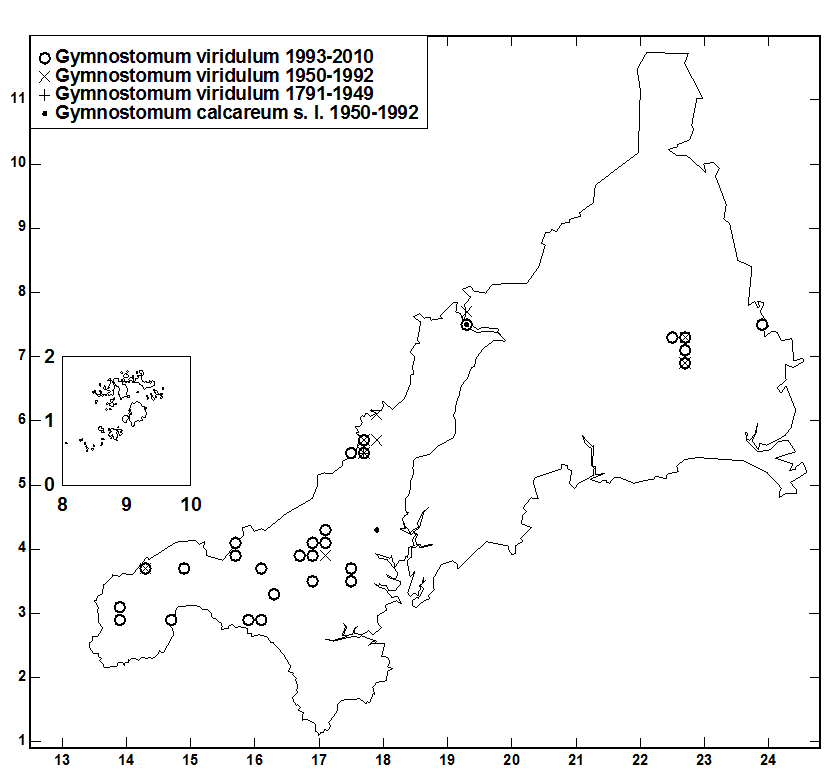
*1: On damp sand around
old mining refuse in dune flats, Wheal Vlow, Gear Sands, 1962,
EWJ, JAP et al.
(NMW, OXF, etc.) (Paton 1969a: 725 as G. calcareum; Whitehouse
& Crundwell 1991: 572, 1992: 48, Blockeel 1992: 26).
[Older report as G. calcareum
(Perranporth sand dunes, in Rilstone 1936) not supported by
specimen: Paton 1969a: 725].
*2: Vertical sandy
sides of old mine rock face, Cassock Hill, Rock, near
Wadebridge, Apr. 1963, JAP (BBSUK, OXF)
(Warburg 1964: 726 and Paton 1969a: 725 as G. calcareum; Whitehouse
& Crundwell 1991: 572, 1992: 48, Blockeel 1992:
26).
G.
calcareum and G. viridulum were not
distinguished in Britain until the
study by Whitehouse & Crundwell (1991, 1992). Older
records that have not been revised subsequently are referred
only to G. calcareum s. l. A few of the
Cornish records may be errors for Gyroweisia tenuis
owing to past confusion over characters of protonemal gemmae
of that sp., which are sometimes indistinguishable from those
of G.
viridulum.
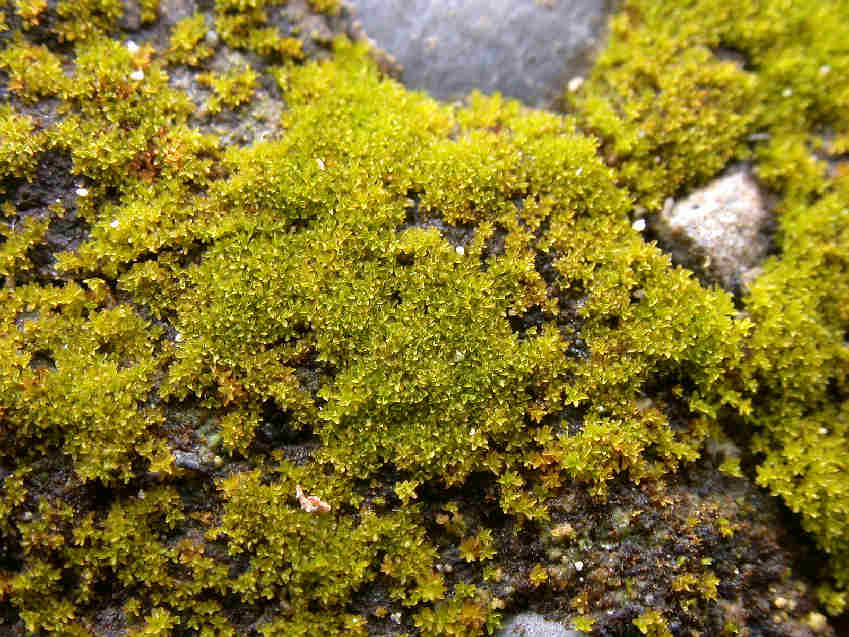
Forms open or dense lawns of tiny plants up to ca 4 mm tall. Notes on
habitats in Cornwall are as follows. Grows mostly on old soft
mortar and thin accumulated soil on tops or ledges of walls
and on other masonry; also single records from walls of it
growing on old bricks and on soft surface of old slates.
Occurs on free-draining substrates, in unshaded and partly
shaded places, although usually where somewhat sheltered and
often where damp in winter. Numerous records are from ruined
mine buildings, sometimes but not always close to areas with
concentrations of copper and other metals. Also on retaining
walls, low on church walls and on wall of a ruined water mill.
Occurs infrequently in other types of site with exposed
free-draining calcareous soil: at Gear Sands on thin soil of
calcareous sand on slopes over old mine-spoil in dune
grassland, with very short incomplete vegetation cover.
Similarly, found locally in dunes at Upton Towans on thin sand
overlying paths constructed from old mine-spoil. At Rock on
sandy soil on unshaded ledges in old slate quarry. Single
record inland on bank of earthy mine-spoil with much decayed
mortar and cement. Usually occurs on surfaces with much bare
substrate exposed, and intolerant of shading by even rather
small mosses. Associates on walls include Aloina aloides, Barbula convoluta, Didymodon tophaceus,
Gyroweisia tenuis,
Pseudocrossidium
revolutum. On earthy mine-spoil or sandy dune slopes with
Aloina aloides, Bryoerythrophyllum
recurvirostrum, Fissidens dubius, Trichostomum
brachydontium, Trichostomum
crispulum.
Protonemal gemmae always present. Two records c.fr.
(Lower Carnkie, vc1, DTH; det. conf. HLKW; 6
Apr 1995, numerous capsules, mostly mature but undehisced, few
dehisced; Minions, vc2, DTH 99-32, 13 Feb.
1999, numerous immature capsules on small patch, all still
green). These were the only records of capsules in
Britain,
but one record existed of them in Ireland (H.L.K.
Whitehouse in Hill et
al. 1992) and they have subsequently been reported from
Wales.
[68.2 Gymnostomum calcareum
Nees & Hornsch. s. str. – Records made
before 1985 are referable to G. viridulum,
reidentified by ACC & HLKW (Hill 1985: 24). The vc2 record
given by Blockeel 1990: 31 and Whitehouse & Crundwell
1991: 569, 1992: 40 is also an error. The specimen (On mortar
of brickwork of shaded walls of derelict mine buildings,
Phoenix United disused mine, N. of Minions, Bodmin Moor, 1989,
RDP conf. HLKW, BBSUK) was reidentified in
1998 as Gyroweisia
tenuis by DTH, conf. ACC, RDP & HLKW (Rothero 1999b:
42)].