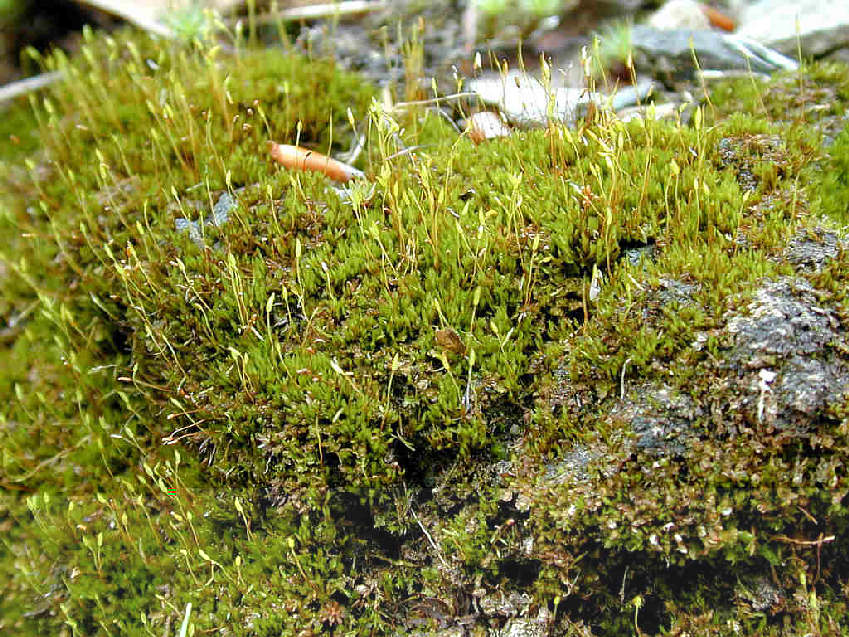
Photo
by Dr M Lueth ©.
*2: On open slope of mine-spoil/slag, N of Minions,
SX27, 1998, DTH 98-374 (BBSUK) (Rothero 2003:
48).
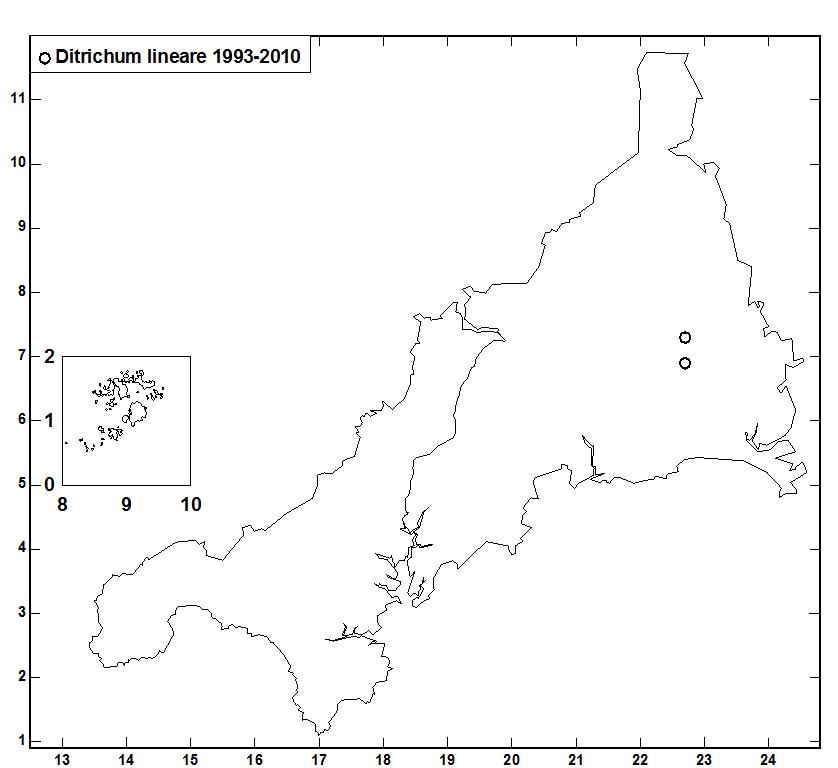
Known inCornwall
only from two old copper-mine areas in vc2, where it was first
collected in 1997 by DTH. The plants are small, rather
featureless, with leaves that are unusually wide with strongly
recurved margins. They were not identified until several years
after they were first found.
A single large patch of ca 450 cm² was present
at Minions in 1998, but this declined progressively and became
fragmented, so that only 3 cm² remained in total in January
2002 and it disappeared soon afterwards, to reappear briefly
for a short time later. It grew on an area of almost
horizontal blackish metalliferous ore that includes much
granular slag-like material and is mainly bare of vegetation,
although a little Funaria hygrometrica
and Cephaloziella
stellulifera is present near to the D. lineare and the
latter species spread over and amongst it from 1998 to 2002,
perhaps as a result of eutrophication from sheep
dung.
Small amounts of D. lineare were
discovered in earthy crevices of a steep retaining wall at
Crow's Nest in 1998, when its population totalled ca 10 cm² , but this
had declined to 6 cm² by March 2000. It disappeared soon
afterwards because the wall was used for climbing practice
that eroded soil from the crevices. Small amounts of Ditrichum cornubicum
and Cephaloziella
massalongi grew with it.
Chemical analyses of the substrate show it
tolerates very high levels of Cu at the Minions locality,
accompanied by moderately high levels of Pb and Zn. The
substrate there is acidic.
Analyses
of substrates from locality in Cornwall (metal
concentrations given as µg/g dry
weight):
LOCALITY
(N samples)
Cu
Pb
Zn
pH
Source
Minions, vc2 (2)
6746-7242
50-238
223-410
5.6
Walsh (2000).
A few tubers have been found on Cornish material.
Only male plants have been recorded in Cornwall (DTH).
Capsules are unknown in Cornwall. Elsewhere in British Isles
mainly female plants known (R.D. Porley in Hill et al. 1992: 96),
although both sexes and capsules recently found in south
Wales
(S.D.S.
Bosanquet, pers. comm.).