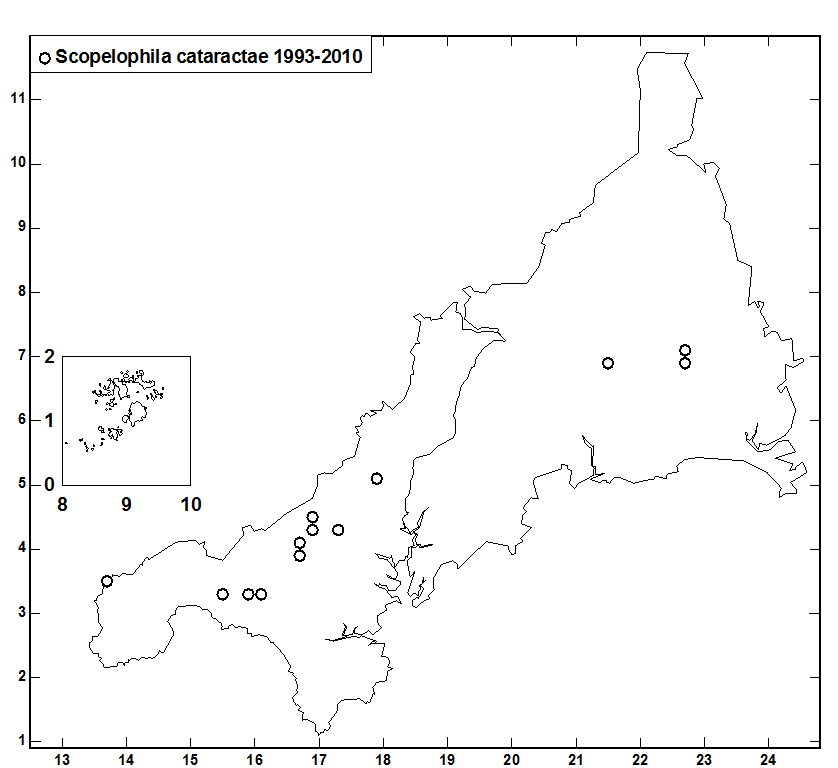
*1: On vertical silty
soil of side of ditch in old mine-waste, shaded by overhanging
grasses and bank, Tuckingmill, SW64, 1994, DTH 94-463
(BBSUK, DTH) (Holyoak 1995b, Blockeel 1996:
45).
*2: On thin soil in
crevices of low wall at edge of patch of old mine spoil, NW.
of Warleggan, SX16, 1998, DTH 98-37 (BBSUK)
(Rothero 1999b: 42).
It is a rather inconspicuous and nondescript moss
restricted to sites with metalliferous contamination. It was
probably overlooked in Cornwall
prior to publication of the first British and European record
by Corley & Perry (1985). Since the first record in vc1
(Holyoak 1995) it has been found to be widespread but very
local in both vc1 and vc2, with more records than from any
other part of the British Is., although often occurring in
small quantity.
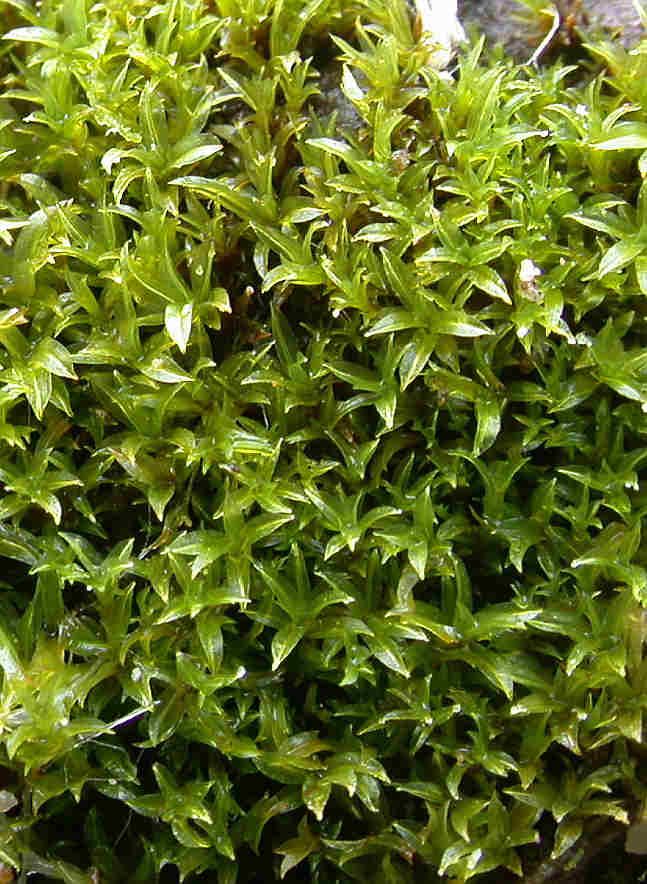
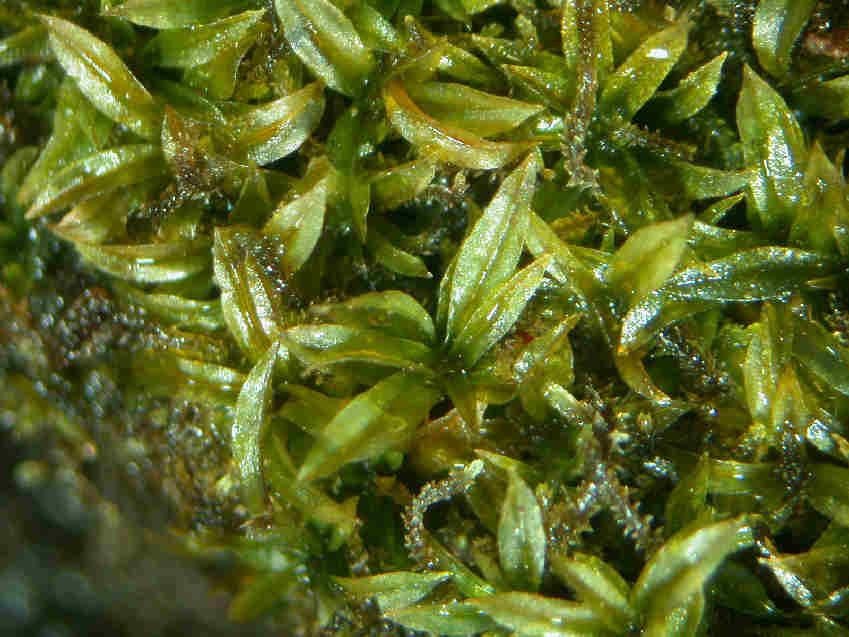
Grows as scattered stems arising from extensive
'felt' of protonemata, sometimes forming patches or more
extensive low turfs, or just as often occurs as scattered
stems or small patches arising from mats of Cephaloziella spp. It
is confined to copper-rich substrates in old mining areas, on
soil that is typically clayey (also clay-silt, silt, and thin
soil in wall crevices), moist, vertical to (less often)
horizontal or overhanging, in unshaded and partly shaded
places. Its habitats are always on or beside old mining ground
and include laneside banks, banks or mounds of old mine-spoil,
spoil at edge of an old mine-shaft, streamside banks, sides of
old leats and ditches, and a vertical low bank of mine-spoil
forming part of a field 'hedge'. Sometimes on mainly bare
substrates and normally in places too toxic to support
vascular plants, but commonly associated with other
copper-tolerant bryophytes, especially Cephaloziella
massalongi,
C.
nicholsonii,
C. stellulifera
and Pohlia
annotina. Also single records of it growing near to Ditrichum cornubicum
and Pohlia
nutans.
A single good patch seen in an unusual situation W.
of Chyverton House on decaying humus of base of Dryopteris tussock,
partly shaded by young birch trees. More substantial patches
were present nearby on damp horizontal clay-silt on banks of a
small stream draining an old mine area.
This species is well known as a 'copper-moss' that
colonises copper-rich substrates on which few other plants can
grow (Shaw 1987, Satake
et al. 1988) and Fletcher (1993) found that in cultivation
it is resistant to applications of a strong copper sulphate
solution. In Europe it has
been found mainly on substrates with a high copper content
(Corley & Perry 1985, Sotiaux et al. 1987, Schumacker
& Brugués 1991) but also where zinc occurs at high
concentrations (van Melick 1986).
As shown in the following Table, chemical analyses
of its substrates show it tolerates high to extremely high
levels of Cu at Cornish localities, whereas levels of Pb and
Zn are high to very high at some sites but quite low at
others. At Chyverton it tolerates simultaneously high levels
of all three metals. All substrates investigated were
acidic.
Analyses of substrates from
localities in Cornwall (metal
concentrations given as µg/g dry
weight):
LOCALITY (N samples) Cu
Pb
Zn
pH
Source
Long Lane, vc1 (2)
161-464
42-139
7-10
6.0
Clements
(1996)
Tuckingmill, vc1 (1)
179
3
20
6.0
Clements
(1996)
Chyverton, vc1 (6)
452-1121
5464-11026
2304-16166
4.1-6.5
Rouen
(2000)
Gilbert's Coombe, vc1 (4) 2024-3512
82-288
245-485
5.1-5.4
Rouen
(2000)
Minions, vc2 (2)
13098-15252
26-31
156-245
5.8
Walsh
(2001).
Studies of six European populations by Shaw (1995)
found no genetic variation at 15 allozyme loci, whereas North
American and many of the Asian populations showed considerable
variability. This tends to strengthen suggestions (e.g. in
Crundwell 1986) that the species may be a recent introduction
to Europe, but the lack of
variability might also be due to few European populations
having survived Pleistocene glaciations.
Not seen c.fr. in Cornwall or indeed anywhere in
Britain or
Europe, where only male
plants have been reported (antheridia seen in July on Cornish
plants). Male and female gametophytes occur in the
U.S.A. but
never in the same population; both sexes of gametophytes and
sporophytes are known over much of its range in Asia and in
tropical America (Shaw 1993,
1995). Vegetative spread presumably occurs by dispersal of the
protonemal gemmae, which were noted in Cornish plants as being
uniseriate and ca 4
cells long, similar to those described by Arts (1988) and
Rumsey & Newton (1989).