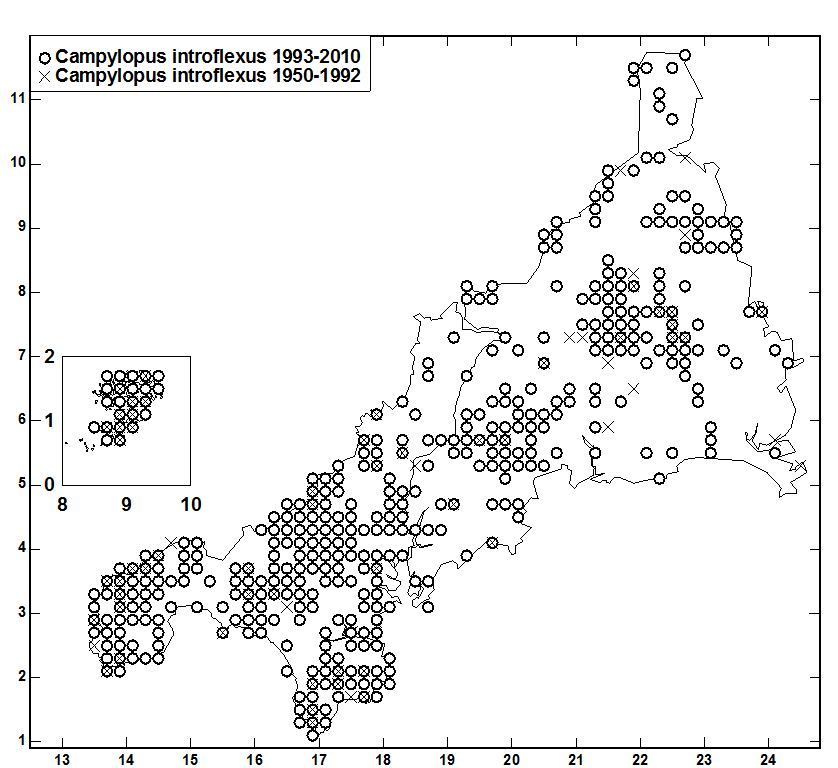
*1: Heathy soil on
cliffs N. of Chapel Porth, St Agnes, May 1960, JAP
(BBSUK) (Warburg 1961: 161, Paton 1969a:
718).
*2: Calluna-heath near
china clay works, America, N. of St Austell, Aug. 1961, JAP
(BBSUK) (Warburg 1962: 367, Paton 1969a:
718).
An alien species that became established in
Cornwall by 1960 and the Isles of Scilly by 1962 (Tresco,
1962, RJM: Paton 1969a: 718). It was noted as 'local but
apparently increasing' through the 1960s (Paton loc. cit.) and had become
common in all regions with acidic soils by about
1995.
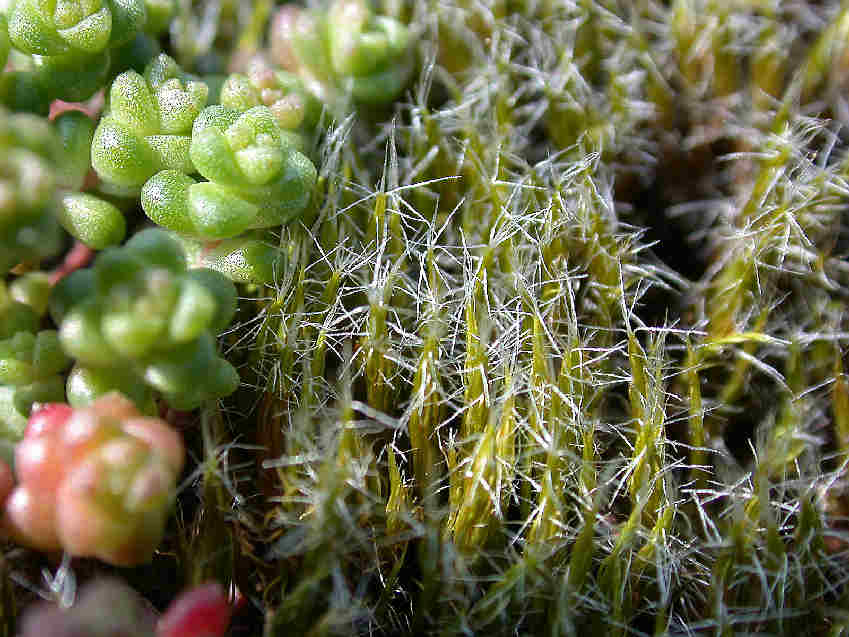
Muticous forms occur frequently, especially with
young plants e.g. on damp track edges. They can easily be
confused with C. subulatus, C. pyriformis and other
congeners, from which they are best separated by careful study
of leaf sections. However, widespread searching among muticous
populations during fieldwork often discloses a few plants in
which short hair points betray the species
identity.
Habitat notes from C&S are as follows. Forms
patches or more extensive lawns, mainly on acidic, dry to wet,
humic or mineral soils, commonly including thin droughty soil
over rocks, but also on bared peat, loose wet litter among Sphagnum, hummocks in
mires (e.g. on a Molinia caerulea
tussock). Patches also frequent on well rotted wood (of
trunks, logs or stumps, including those of pine, oak and Tamarix), not rare
also on old timbers of fences or buildings, or on old burnt
wood. Rarely on rocks with little or no accumulated soil, e.g.
on granite among china-clay spoil, but less typically growing
directly on rock than Campylopus pilifer.
Seen three times in small amounts as epiphyte (1.5 m above
ground in hollow where branch had rotted on hedgerow oak; on
living horizontal branch of Grey Willow; on bark at base of
old pine trunk). Two records on old tarmac at edge of paths
(once as large patches), rotting fabric dumped beside track,
old roofing felt lying on ground, and on rotting vinyl of
wrecked car.
Often abundant in open areas on coastal and inland
heaths, such as beside paths and tracks and commonly occurring
extensively for a few years on soil exposed by fires. Frequent
in many other habitats, including disturbed areas in acid
grasslands, banks in open woodland (deciduous and coniferous),
woodland clearings, 'hedges', quarry slopes and spoil, partly
bare areas on old copper mine-spoil (in open or partly under
Calluna vulgaris or
Ulex scrub),
china-clay quarries and spoil and almost bare areas above
sea-cliffs (including exposed sites that receive much salt
spray). Young plants locally abundant on peaty substrates in
upper part of inundation-zone beside Colliford Lake (reservoir). Other
records from acidic sand dunes (Isles of Scilly), gravel
covering graves, soil in gardens, plant pots in nurseries and
garden centres, track of disused railway, a church roof, and
accumulated 'soil' in guttering of house roof. Commonest in
unshaded places, but frequently in light
shade.
Frequent associates include many common acidophiles
such as Campylopus
fragilis, Campylopus pyriformis,
Cephaloziella
divaricata, Ceratodon purpureus,
Dicranella
heteromalla, Trichostomum
brachydontium, Sedum anglicum; many
others recorded include Bryum torquescens,
other Campylopus
spp., Cephalozia
bicuspidata, Dicranum scoparium, Hypnum cupressiforme
var.
resupinatum, Nardia
scalaris, Orthodontium lineare,
Sphagnum
denticulatum, Aphanes sp. On Isles
of Scilly associates often include Lophocolea bispinosa,
Lophocolea
semiteres.
This alien species now covers large areas on
coastal slopes and open parts of coastal and inland heaths,
becoming especially conspicuous 1-3 years after fires. It
commonly covers so much ground that it must have had a
deleterious effect at least locally on other bryophytes
occurring in these habitats, such as Campylopus atrovirens,
C. brevipilus and C. pilifer. Although
widespread, it is much less plentiful on wet ground in mires
and in regions with fertile soils it remains a scarce
colonist, mainly on decaying wood (and once on gravel beside
sewage farm).
Vegetative dispersal apparently common by means of
deciduous leaves and fascicles of young leaves. Commonly
c.fr.: capsules immature 1-6, 11, 12; dehiscing [1], 5-10;
dehisced 1, 3-12.