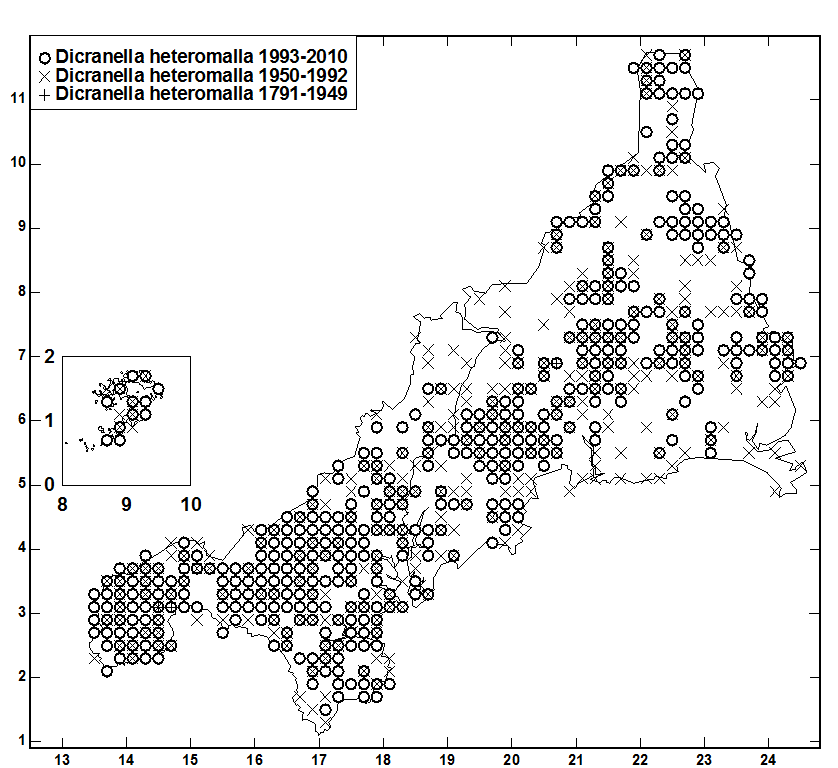
*1: Trengwainton
quarry, Penzance, 1861, WC (PNZ) (Paton
1969a: 716).
*2: Near Clerkenwater,
N. of Bodmin, 1887, RVT (B) (Paton 1969a:
716).
Habitat notes from C&S are as follows.
Characteristic of acidic soil (humic and mineral, dry to
rather moist) on banks and slopes in woodland. It is most
abundant in places where leaf-litter does not accumulate, in
which it often forms large, fertile patches (low lawns).
Besides sites in woodlands (deciduous and conifer) and wood
edges, it occurs in scrub, Grey Willow
carrs, beside lanes and on other banks, in old quarries, on
'hedges', on stream banks, and among boulders or rocks of
tors. It typically grows at least partly shaded and tolerates
heavy shade, e.g. as mainly non-fertile plants under
overhanging banks and in deep crevices among rocks. However,
smaller amounts occur in a wide range of other habitats, some
entirely unshaded, e.g. in cemeteries, churchyards, on mainly
bare mine-spoil, on sea-cliffs, and on heathland. A few
records of small tufts on rock, e.g. in small shallow crevice
in granitic boulder. Associates commonly include Calypogeia arguta, Calypogeia fissa, Diplophyllum albicans,
Kindbergia
praelonga, Fissidens bryoides
var. bryoides,
Solenostoma
gracillimum, Pogonatum aloides, Pseudotaxiphyllum
elegans; less often Atrichum tenellum, Bryum bornholmense, Dicranella crispa, Dicranella rufescens,
Fissidens celticus,
Lophocolea
fragrans, Phaeoceros laevis, Pogonatum nanum, Pohlia
lutescens.
Single record of small amount on soil near edge of
arable field (cereal stubble). Besides its usual soil
substrates, recorded as colonist on crumbling granitic rocks
and on clay surfaces locally in working china clay quarries
and on spoil heaps. Occasionally on moist bared peat in mires,
especially on sides of hummocks. Also once on bark at base of
oak trunk in grove of trees, and once a bit on well rotted,
decorticated wood of fallen log in shade of deciduous
woodland. Also once on rotting bark of branch on ground under
trees and on a stump with Campylopus flexuosus.
Non-fertile plants were the only colonist on some parts of
very contaminated silt-clay and humic soils beside spring and
near stream draining old mine area (W. of Chyverton
House).
Commonly c.fr.: capsules immature 1-3, [5 very
young], 6-12; dehiscing [8*], [9], 11, 1-4, [5]; dehisced 1-8,
10. (* Dehiscing capsules twice seen in plenty in early Aug.,
but this unusual).