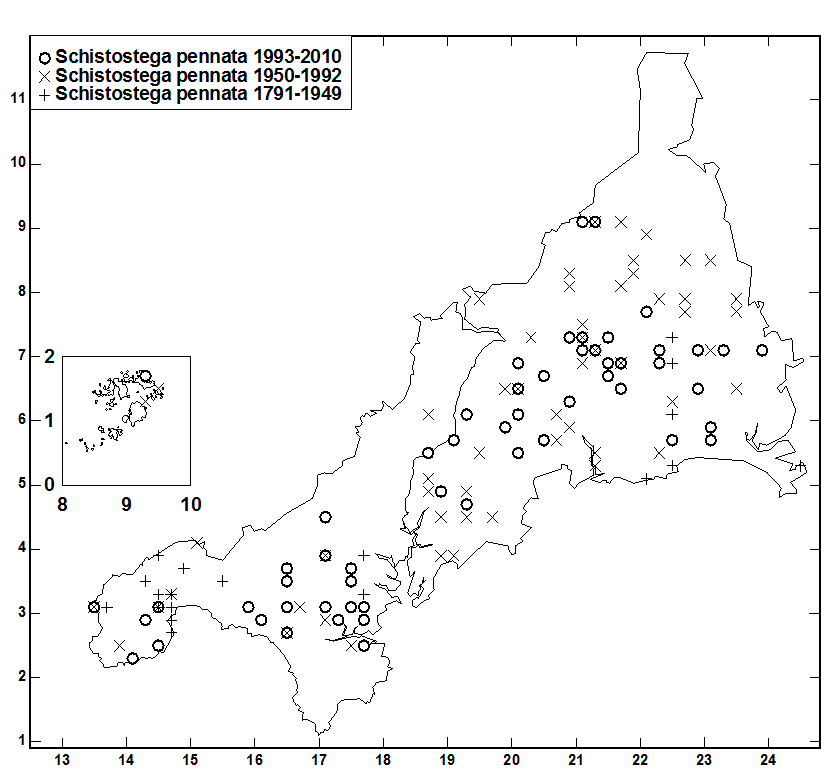
*1:Penzance, 1839, WC & JR
(TRU) (Paton
1969a: 732).
*2: St Cleer, 1920, RWS
(TRU) (Paton 1969a:
732).
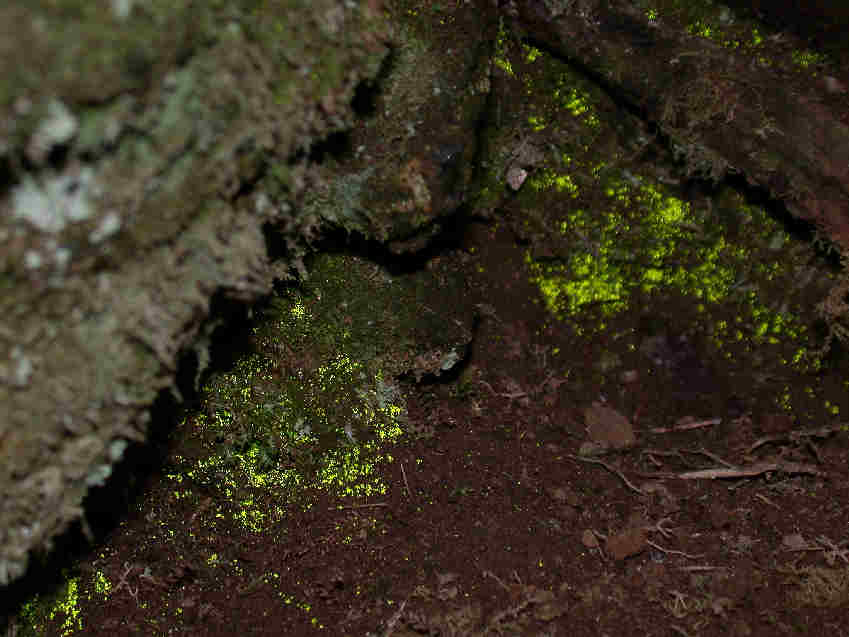
Occurs as glistening golden-green protonemata
('Goblin's Gold'), as small patches or sometimes covering tens
of square centimetres, giving rise in most sites to scattered
leafy stems that may form sparse low turfs. A few finds of
protonemata without gametophores have not been recorded as
distributional records of the species (e.g. in deep, dark
crevice low on a sea-cliff W. of Wine Cove, St Martin's) as
there may be slight doubt that some alga or other protonemata
could be confused.
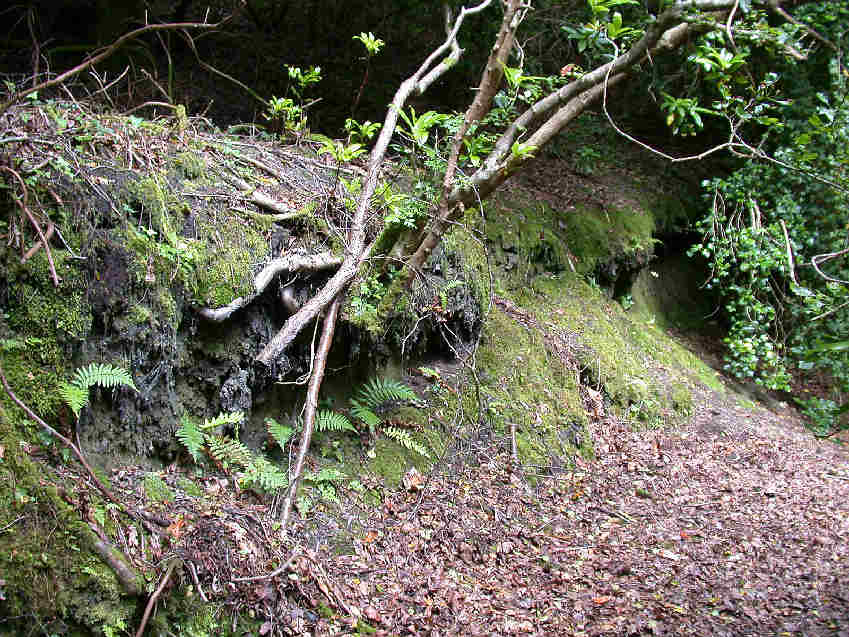
Grows on overhanging, vertical, steep, or
horizontal, friable loamy or silty to rather humic or hard or
rocky, ± acidic soils in rather dry sites beneath overhangs of
banks or exposed tree roots. It grows in places that are
sheltered and often rather humid, but where it receives little
or no rainfall or water dripping from above. Most sites are on
roadside or laneside banks, usually where partly shaded by
trees and often well shaded by e.g. wood edges or actually
within woods, but there are a few records from open places
including sea-cliffs, a few from hollows in old 'hedges',
small old quarries and two from high on well shaded stream
banks.
A single large patch was recorded on overhanging
soil at the base of a wind-thrown Beech tree on a steep stream
bank in woodland, but there are no other records from
wind-thrown tree bases (its usual habitat in C. Russia:
Ignatov & Ignatova 2001). One record inside entrance to
animal burrow (rabbit?) inside wood
edge.
H.J.B. Birks (in Hill et al. 1994: 50)
stated that 'associates are rare' but this is untrue in
Cornwall. Frequent or common
associates here are Calypogeia arguta and
Pseudotaxiphyllum
elegans, weak plants of Dicranella
heteromalla, Kindbergia praelonga,
Fissidens bryoides
var. bryoides, Mnium hornum and Pogonatum aloides,
with a few records of Epipterygium
tozeri.
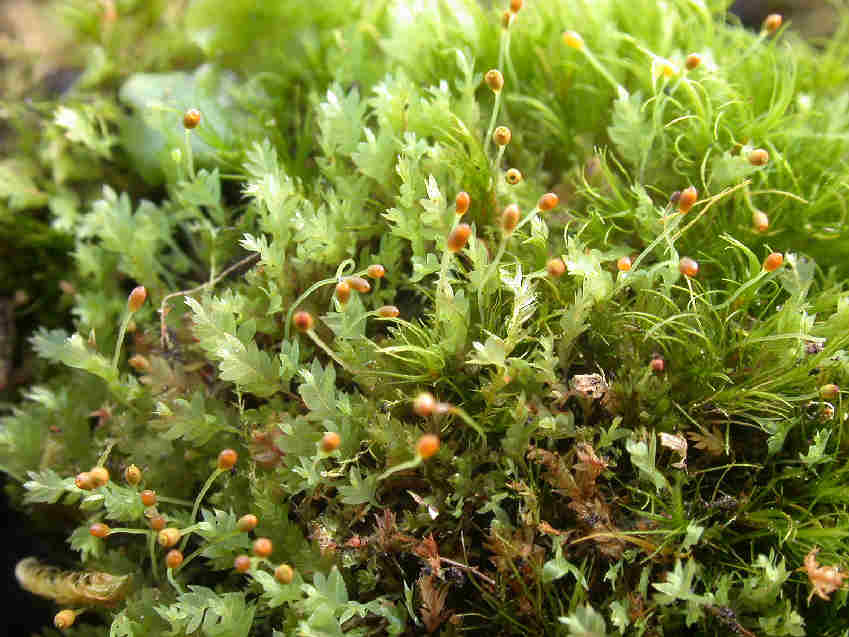
Occasionally c.fr. Capsules: immature 2, 4,
dehiscing 4-6, dehisced 8.