Photo
by Dr M Lueth ©.
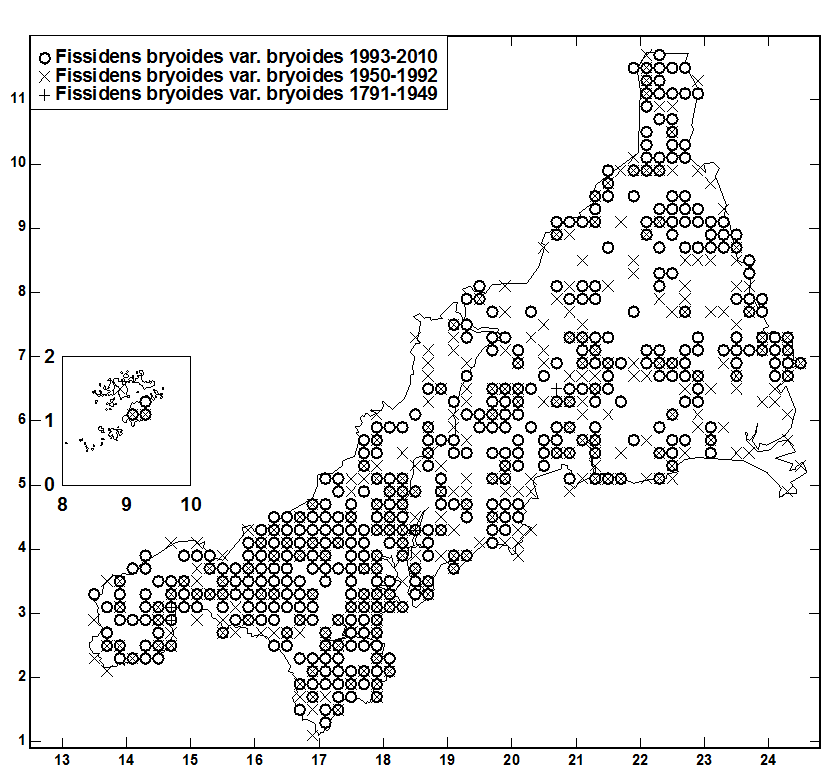
*1: Sunset, Kea near
Truro, 1845, EAW (TRU) (Paton
1969a: 712).
*2: Halgavor Moor, S.
of Bodmin, 1879, RVT (B) (Paton 1969a:
712).
Small plants are easily misidentified as F. viridulus, since
stunted F. bryoides var. bryoides may lack male
buds in the leaf axils on all but a small minority of plants.
F. bryoides var. bryoides can also be
difficult to separate from small forms of F. bryoides var. caespitans (q.v.) with which it is
apparently connected by intermediates. However, F. bryoides var. bryoides is more widespread inCornwall
and often commoner than both of these.
Scattered plants or forming lawns. Habitat notes
from C&S are as follows. Normally on neutral to moderately
acidic mineral soils, on horizontal, sloping or vertical
surfaces that are rather dry to moist, but not permanently
wet. Commonest in light to moderate shade, but sometimes fully
insolated and frequently also growing (non-fertile) in deep
shade in crevices and under overhangs on banks. Common in
woodlands, groves of trees (deciduous and conifers) and scrub,
on laneside banks, stream banks, on 'hedges' and on and above
sea-cliffs, but also recorded from bare patches or banks in
pastures, a damp cattle-trodden track, Grey Willow scrub,
cemeteries, churchyards, old quarries, old mine spoil, a bank
beside a reservoir, and banks or spoil heaps of china clay
near quarries. Commonly on thin soil over rocks and
occasionally in moist rock crevices, but not usually growing
directly on rock although occasionally seen on soft rock
surfaces in sheltered places. Frequent associates include Calypogeia arguta, Calypogeia fissa, Kindbergia praelonga,
Fissidens taxifolius
var.
taxifolius, Lophocolea bidentata,
Mnium hornum, Plagiothecium
nemorale, Plagiothecium
succulentum, Rhizomnium punctatum,
Conocephalum
conicum; others recorded include Bryum sauteri, Trichodon cylindricus,
Epipterygium
tozeri, Oxyrrhynchium hians,
Oxyrrhynchium
pumilum, Fissidens
exilis, Pleuridium
acuminatum, Tortula
truncata.
Commonly c.fr. [recorded mainly when evident that
capsules are erect]; capsules immature 1-3 [4 few], 6, 9-12;
dehiscing 1-4 [5-9], 10-12; dehisced 1-10 [11
old].