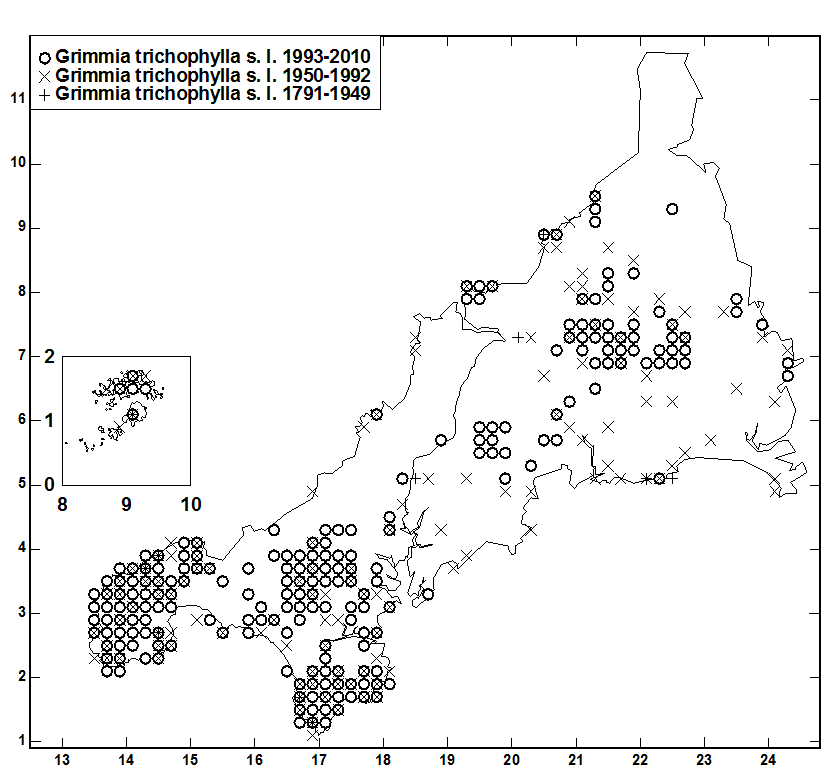
*1: Trungle near Paul,
1867, WC (PNZ) (Paton 1969a:
729).
*2: Near St Erme, 1861,
ES (TRU) (Paton 1969a:
729).
G. lisae
was treated as a distinct species from G. trichophylla by
Greven (1995) and Muņoz & Pando (2000), but characters
allowing its separation from several similar species remained
unclear until the paper by Maier (2002). Since then specimens
from Cornwall have been revised and treated as G. lisae or G. trichophylla s. str. (see separate
accounts ); a
third species of the group, the calciphile G. dissimulata E.Maier,
is known elsewhere in southern England but has not yet been
found in Cornwall.
Forms cushions and small patches that may extend or
coalesce to form larger patches or low lawns. Notes on the
habitats of the s. l. species in C&S
are as follows (each species is also treated separately
below). Grows mainly on hard dry rocks, including base-poor
types (granitic, shale, slaty, gabbro, greenstone) and
serpentinite, on open surfaces, small ledges and in crevices,
on horizontal to steeply inclined surfaces. Occurs on
boulders, blocks, natural outcrops, walls (including those of
churches), rocks in 'hedges' and quarries, and on gravestones,
most often in unshaded or lightly shaded places or part shaded
e.g. by bushes or in open woodland, but more rarely well
shaded inside deciduous woodland or groves. Sometimes common
on upper cliff slopes and cliff tops, so evidently tolerant of
salt spray. A few records also from within regularly flooded
zones beside rivers, a reservoir and a
pool.
G.
trichophylla s. l. sometimes grows on
granitic rocks within or capping mortared or concrete walls,
but usually not directly on the calcareous substrates. Several
such records from granite parapets of bridges over R. Inny and
R. Tamar are in regions otherwise unsuited to the species.
Single record of several small patches (checked
microscopically) from sloping concrete on grave, close to Didymodon luridus and
Tortula muralis, so
surely on a basic substrate there, as also on old concrete
beside steps on exposed coastal slope. Despite rarity of
capsules it often colonises isolated patches of suitable rock
away from the natural outcrops of granite, especially old
granite (or less often slaty) gateposts, gravestones, masonry
debris, rocks in walls and stonework of larger bridges. An
unusual record of substantial patches of low plants on old
tarmac of edges of path in churchyard.
Associates often include Bryum capillare, Dicranoweisia cirrata,
Hedwigia stellata,
Hypnum
cupressiforme var. resupinatum, Racomitrium
heterostichum, lichens; also Sciuro-hypnum plumosum
in a river flood-zone. Common alongside the mainly more
basiphilous G. pulvinata (q.v.) on serpentinite,
but mostly replaces that species on granitic rocks, except at
a few coastal localities where they occur together. G. trichophylla s. l. entirely replaces
G. pulvinata on gabbro
at Lowland Point.
Single record c.fr. by DTH: capsules immature 11
(few, patch on boulder partly sheltered by scrub).