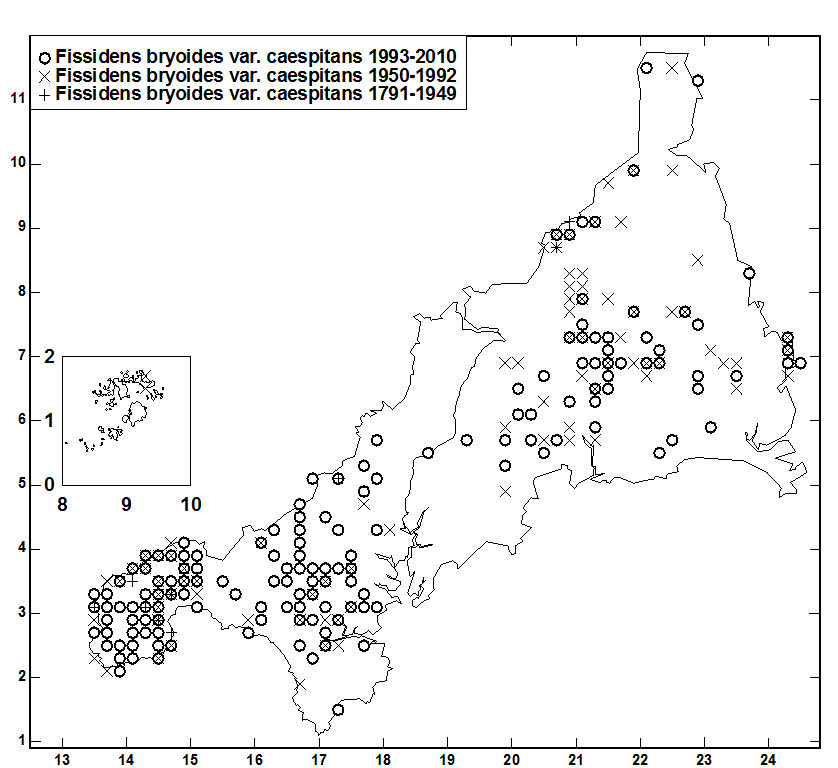
*1: Newlyn Cliff, 1861,
WC (OXF) (Paton 1969a: 712-713). The Holotype
was from Newlyn Cliff.
*2: De Lank R., 1961,
JAP (BBSUK) (Paton 1969a: 712-713). [Earlier
record (De Lank R., in Tellam 1892) not supported by specimen:
Paton 1969a: 712-713].
The recent recognition that this taxon commonly has
brown rhizoids in Cornwall (Holyoak &
Whitehouse 1998) suggests that it was under-recorded in the
past, when only the somewhat scarcer plants with red rhizoids
were placed here (cf. Smith 1978: 194). Plants with brown
rhizoids are likely to be mistaken for F. bryoides var. bryoides, since that
taxon can also have multistratose leaf borders, but var. caespitans has
inclined capsules and larger spores (many >16 µm), and it is
commonly taller. However, some plants are undoubtedly
intermediate and this probably justifies their treatment as
varieties rather than species..
Some plants from Siblyback
Lake
resemble F. pusillus in their
small size but have antheridia on dwarf axillary branches and
inclined capsules; since larger F. bryoides var. caespitans is present
close by these are interpreted as dwarf plants of the latter
taxon.
It usually forming pure patches or lawns, but
occurs also as scattered stems. Habitat notes from C&S are
as follows. The usual substrates are thin soil over rock or it
grows directly on rock surfaces (slaty, granitic), often also
on firm soil, several times seen on concrete and other masonry
and occasionally on exposed tree roots e.g. of Alder; most
often on steep or vertical surfaces but also on horizontal
ones. It grows in damp or wet places and mostly close to
water-level of streams (within 0-35 cm, so commonly within the
flood-zone; sometimes where shallowly submerged even in
summer), but also on flushed rocks away from streams or
rivers, such as on sea-cliffs, on a hill top, in a disused
railway cutting and in old quarries, and in upper part of
inundation zones beside reservoirs. It usually grows partly to
moderately shaded, typically by trees, Grey Willow scrub or
banks, but is sometimes fully insolated, or rather heavily
shaded. Twice seen on moist loamy soil near graves in
churchyards, once on damp soil under elms (where occasionally
flooded) and several times on damp humic soil under Alder or
Grey Willow carrs. More atypical
records are from the wet clayey surface of wall of ruin of
china clay 'dry', in shaded interior of old mine adit high on
a sea-cliff and on flushed rocks well inside a large sea-cave.
Associates recorded include Fissidens
adianthoides, Mnium
hornum, Plagiothecium
nemorale, Rhizomnium punctatum,
Platyhypnidium
riparioides, less often Fissidens polyphyllus,
Heterocladium
heteropterum var.
heteropterum, Heterocladium
wulfsbergii, Trichostomum
tenuirostre.
Commonly c.fr. (although non-fertile when submerged
all year): capsules immature 1-6, 9-12; dehiscing 1-6 [7],
[9], 11, 12; dehisced 1, 4, 5, 7,
8.