|
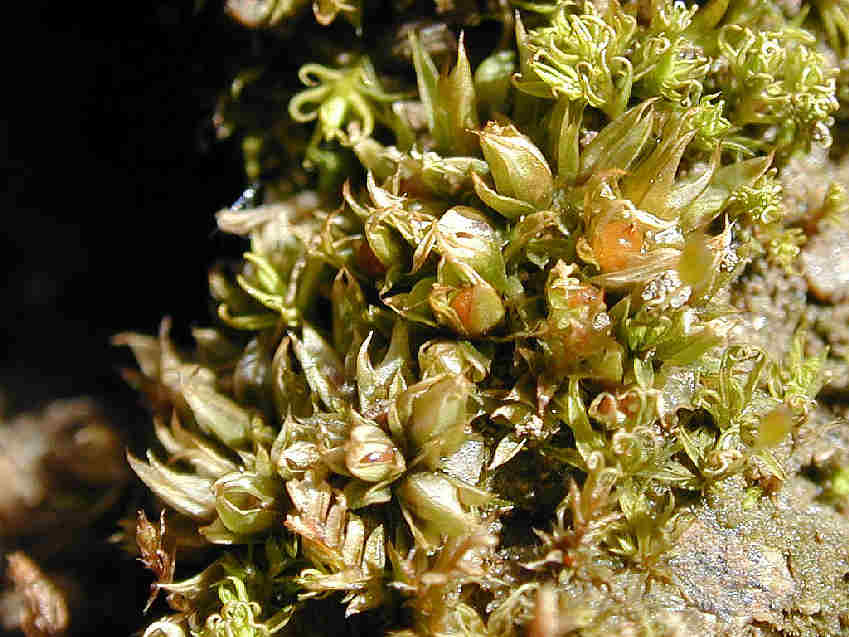
Photo
by Dr M Lueth ©.
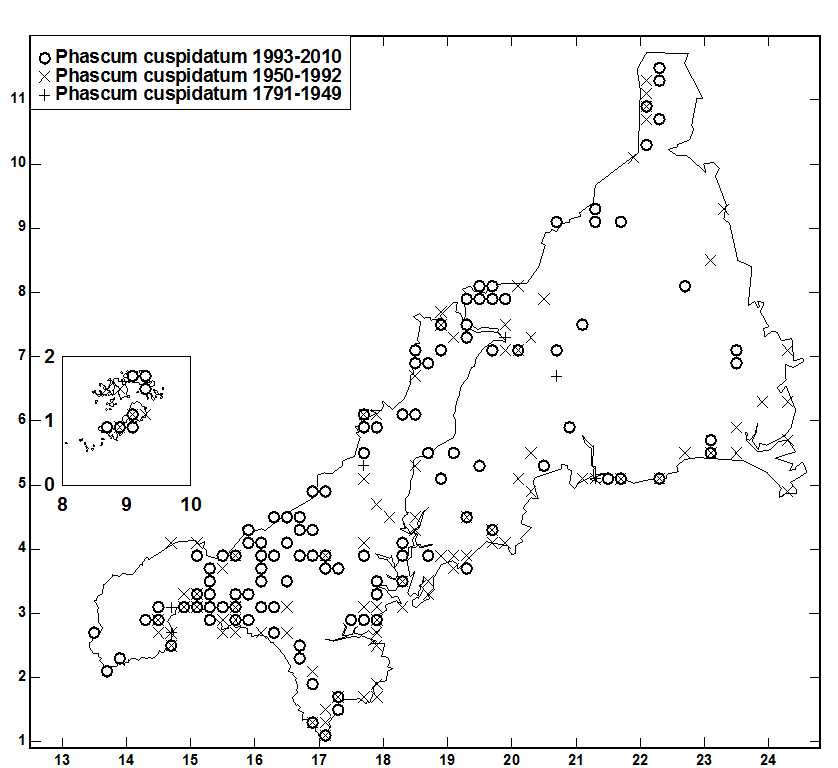
First vice-county records of P. cuspidatum s. l.:
*1: Newlyn Cliff, 1867, WC (PNZ) (Paton 1969a:
723).
*2: Polruan, 1891, RVT (B) (Paton 1969a:
723).
For recognition of var. papillosum see
Blockeel (1995). The s. l. consists
of vars. cuspidatum
and papillosum, but
excludes var. piliferum
.
Records of habitats, associated plants and timing
of sporophyte production have been kept separately for each of
the three vars. and these are given separately below. There do
not appear to be any differences in habitats or phenology
between var.
acaulon, var. papillosum or the many
intermediates between them. However, the much scarcer var. pilifera differs in being restricted to free-draining
substrates in sunny coastal sites.
All three vars. grow as scattered plants or small
patches, often among other mosses. The species is a colonist
of bare basic to neutral (or slightly acidic?) soil, whether
extensive as on soil heaps or in arable fields (all types) or
as small patches, e.g. in grass-leys. Associates recorded (of
P. cuspidatum s. l.) are Barbula convoluta, Barbula unguiculata,
Bryum dichotomum,
Bryum
klinggraeffii, Bryum rubens, Bryum violaceum, Trichodon cylindricus,
Funaria
hygrometrica, Pleuridium
subulatum, Tortula
truncata. Usually also with herbaceous weeds on arable
fields, e.g. Cerastium
glomeratum, Lamium
purpureum, Sinapis
arvensis, Stellaria
media, Urtica
urens, Veronica
persica.
All records, including those assigned to subspp. or
vars.: commonly c.fr.: capsules immature 1-4, 7, 10-12;
dehiscing 1-6, 8-12.
|