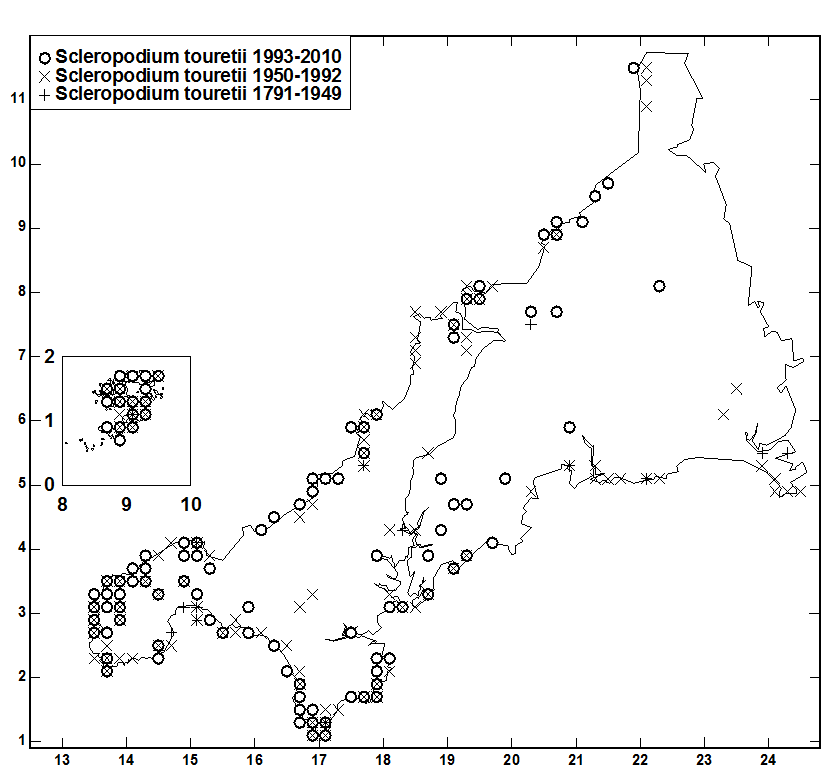
*1: BetweenTruro
and Calenick, 1828, JST (RAMM) (Paton 1969a:
751).
*2: St Kew
Highway, 1888, RVT
(B) (Paton 1969a: 751).
Typical plants of this species are common
in the Isles of Scilly in unshaded habitats with sparse or
very short vegetation, such as on edges of rocky paths. In
addition, plants of this genus have been collected from shaded
habitats there, e.g. on granitic rocks under elm trees and on
sandy soil in bulbfields, some of them closely resembling
S.
cespitans in having longer, straighter and more
slender leafy stems than typical plants of S.
touretii, although they are generally rather
featureless and sometimes more slender than is usual even in
S.
cespitans, with longer acuminate leaf apices.
However, the shade plants from Scilly often grow in drier
habitats than those usual for S.
cespitans on the mainland, in places that are not
subject to periodic inundation. Hence, and also since a full
range of intermediates connect the Scillonian shade plants
with typical S.
touretii, they are all referred to the latter
species. González-Mancebo & Hernández-García (1996) report
similar variability within S.
touretii
in the Canary Islands, where
an extremely slender form with elongate leaf apices has been
named as var. teneriffae Cardot & Wint.,
although they show that it is connected to the typical form by
intermediates. The slender forms are shown by these authors to
occur in habitats with higher humidity conditions and lower
light intensity than those where the typical form is growing,
as in the Isles of Scilly. The only mainland record of a well
marked 'shade form' (resembling S.
cespitans
) was from
S. of Georgia in W. Penwith
in 1996: in middle of little-used track in former china clay
works, amongst short grasses and herbs, but partly shaded by
tall Grey Willow scrub (typical S.
touretii
was recorded in same area in 1965 by JAP,
before the scrub grew up).
Habitat notes from C&S are as follows.
Commonest at or near coast in unshaded places that are dry for
long periods in normal summer conditions, with very short turf
or almost bare ground. Found on basic to acidic soil, often
where soil is thin over rocks or compacted on or beside
pathways or tracks, overlying many rock types (slates, schist,
greenstone, granitic, serpentinite). Locally abundant at
Porthallow in trampled areas just above head of shingle beach.
Common associates include Archidium
alternifolium, Bryum dichotomum, Campylopus
introflexus, Ceratodon purpureus,
Fossombronia spp.
especially F. 'husnotii', Pleuridium
acuminatum, Riccia
subbifurca and Trichostomum
brachydontium, Cladonia spp., and
various low phanerogams (especially Aphanes sp., Festuca rubra, Plantago coronopus, Poa annua, Sedum anglicum).
Others recorded include Barbula unguiculata, Bryum kunzei, Bryum torquescens, Grimmia lisae, Hypnum cupressiforme
var. lacunosum, Lophocolea
bidentata, Lophozia
excisa, Tortula
wilsonii, Weissia
longifolia var.
longifolia. Frequently occurs in exposed sites subject to
salt-spray.
Records inland are mainly of smaller amounts in
similar unshaded habitats on tracks, partly-bare roadsides, in
an old quarry, at edge of gravelly car park, sandy ground
trampled and grazed by rabbits at landward edge of dunes, a
bank on old mining ground, a rocky patch on laneside bank,
side of a 'hedge'; once among low mosses on old crumbling
mortar of top of wall of ruin; once a small patch on
horizontal concrete by path in edge of scrub; once on
near-horizontal low slaty rock at road edge where partly
shaded by woodland trees.
Habitat range more extensive in Isles of
Scilly than on mainland, where shade forms can resemble S.
cespitans
(see
above). Besides records on paths, tracks, etc., recorded there
in bulb fields (on firm sandy soil, and on soil partly shaded
by herbaceous weeds), on old mortar of base of wall beside
lane (St Martin's), and on low concrete wall in Tresco Abbey
Gardens, both of the latter sites almost unshaded, However,
records of 'shade form' were on granitic boulders partly
shaded by elm
trees near Tresco Abbey, and on similar substrates but well
shaded by elm trees beside small stream (ditch) near
Lenteverne on St Mary's.
One record c.fr. (vc1; DTH):
capsules immature 9.