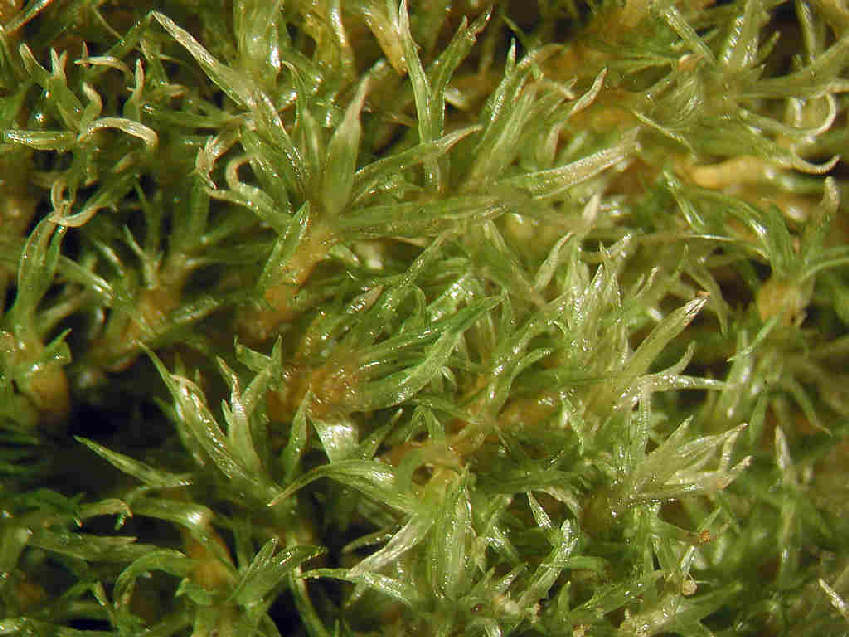
Photo
by Dr M Lueth ©.
*1: On old crumbling
mortar of top of low wall of ruined mine-building, N.-facing
and partly shaded by other walls, Wheal Busy, E. of Scorrier,
SW74H, 1995, DTH 95-375, det. J. Kucera
(BBSUK) (Rothero 2002:
46).
Rhizoidal tubers occur abundantly on the Wheal Busy
specimen. Not seen c.fr.
Other specimens from W. Cornwall and Isles of
Scilly are difficult to identify and are regarded as most
likely D. australasiae (Hook.
& Grev.) R.H.Zander (J. Kucera, pers. comm.) since they
lack tubers, have the leaf margin unistratose or with a few
bistratose patches and the lamina cells are papillose, but the
identification was also based partly on DNA sequence data from
one of the Cornish specimens. D. australasiae is not
formally accepted as a British species, but like Kucera (pers.
comm.), Jiménez (2004) and Jiménez et al. (2005) treat D. australasiae and D. umbrosus as distinct
species.
This vc1 material lacks tubers, but it differs from
D. vinealis in hyaline
basal cells of the leaf and the often slightly hooded leaf
apex. The straight leaves and usually deep green (to almost
blackish) colour attract attention. It grows as small patches,
usually among other low mosses, or extends to form low
lawns.
There are several recent records from Isles of
Scilly (some originally presumed to be D. umbrosus not D. australasiae): on
soil of unshaded to part shaded tracks among bulbfields on St
Agnes (discovered by RAF, 2002); 'D. umbrosus' was also
found on St Mary's (2002, DTH) at Porthcressa (on compressed
soil of partly bare patches of unshaded lawn on coast) and at
Harry's Walls (abundantly on gravel in open and part shaded,
sometimes with other low mosses).
Specimens from the mainland of
W. Cornwall, are from unshaded sandy ground near the coast in
and around the Towans, e.g.: At Gwithian forming substantial
low patches on unshaded open sandy ground with patchy short
vegetation by path near cliff top. Near Hayle on old track
near edge of dunes. Truthwall on track inland. At Lelant on
disturbed sandy ground and over concrete of floor of ruin.
NearHayle
Harbour
on open sandy ground with other low mosses. Also near
Porthgwarra on thin soil in small hollows of unshaded track
edge close to concrete. Associates in these mainland sites
include Barbula
convoluta, Barbula
unguiculata, Brachythecium mildeanum
(sparse), Bryum
dichotomum, Didymodon fallax, Didymodon insulanus,
Pseudocrossidium
hornschuchianum. A small patch at Porthallow grew with
other low mosses just above head of shingle beach (with Barbula convoluta
var. sardoa, Barbula unguiculata,
Bryum dichotomum,
Funaria
hygrometrica).