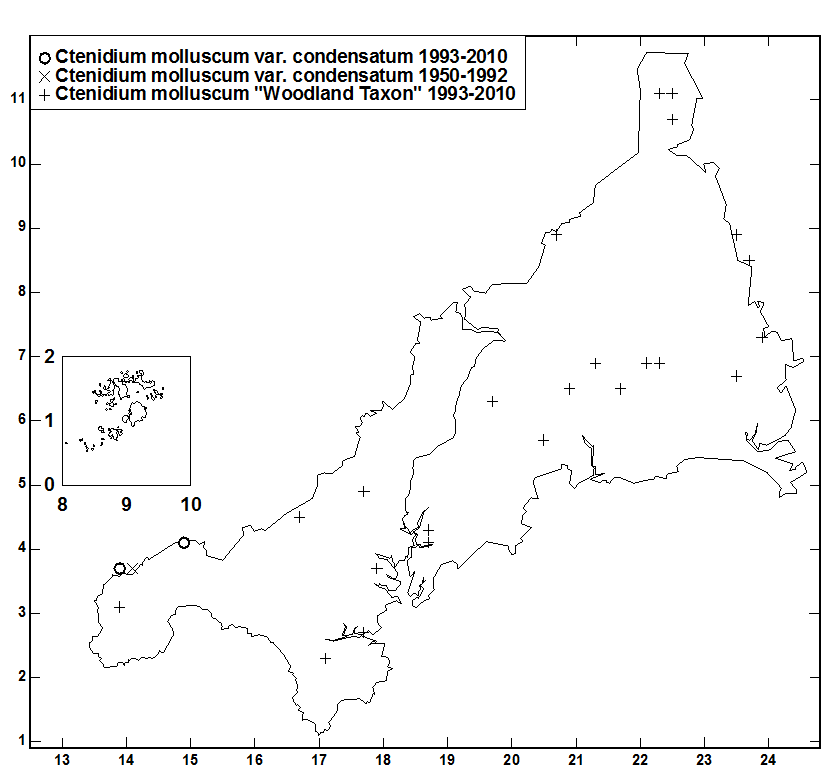
This was described by Smith (1978: 659, 661; 2006:
917-920) as differing from var. condensatum in having
branch leaves shorter than stem leaves and in being a
calcifuge plant of soil in woodland rather than a calcicole of
basic rocks. This taxon has never been given a valid name (C. molluscum var. sylvaticum F.Rose,
1980 as cited by Smith 1979 in the paperback edition of Smith
1978 was in fact never published, fide Dr A.J.E. Smith
pers. comm.); the account in Smith (2004: 920; 2006: 920)
lacks a Latin diagnosis. Paton (1969a: 755) mentioned
occurrences of 'The woodland form' in both vice-counties, but
it was not recorded separately by Corley & Hill (1981) or
Hill et al. (1994:
389). Morphological differences between the 'Woodland Taxon'
and slender plants of var. condensatum appear to
be slight and the preference for acidic rather than basic
soils hardly seems sufficient to justify separate taxonomic
treatment.
Recent records of the 'Woodland Taxon' from
Cornwall have the following habitat notes. Grows as patches or
more extensive low mats. On firm soil (loamy, clayey, hard and
stony), low granitic rocks, granitic boulders or slaty rock,
on flat ground, slopes or banks in deciduous woodlands, groves
of trees, on stream banks and on laneside banks. Grows in
lightly to well shaded places, apparently often in places with
at least some base in the soil. Associates recorded are Kindbergia
praelonga,
Fissidens bryoides var. bryoides, Plagiochila
asplenioides,
Rhizomnium punctatum; once Plagiothecium
cavifolium.
A gathering from Lower Bostraze (SW33V) is closest
to this form, but growing on near-vertical concrete of partly
shaded base of an old wall (of a ruined china-clay
dry).
Few records c.fr. (only one record in vc1, winter:
DTH). |