THE BRYOPHYTES OF CORNWALL
AND THE ISLES OF SCILLY
by
David T. Holyoak
| A B C D F G H J K L M N O P R S T | Layout notes | Abbreviations | People's initials | Herbaria | Full Text PDF |
Liverworts(MARCHANTIOPHYTA)Adelanthusdecipiens Anastrophyllum minutum Aneura mirabilis Aneura pinguis Aphanolejeunea microscopica Barbilophozia attenuata Barbilophozia barbata Barbilophozia floerkei Bazzania trilobata Blasia pusilla Blepharostoma trichophyllum Calypogeia arguta Calypogeia fissa Calypogeia muelleriana Calypogeia sphagnicola Cephalozia bicuspidata Cephalozia catenulata Cephalozia connivens Cephalozia leucantha Cephalozia lunulifolia Cephalozia macrostachya Cephalozia macrostachya var. macrostachya Cephalozia pleniceps Cephaloziella calyculata Cephaloziella dentata Cephaloziella divaricata Cephaloziella hampeana Cephaloziella integerrima Cephaloziella massalongi Cephaloziella massalongi s. l. Cephaloziella nicholsonii Cephaloziella rubella Cephaloziella spinigera Cephaloziella stellulifera Cephaloziella turneri Chiloscyphus pallescens Chiloscyphus polyanthos Cladopodiella fluitans Cladopodiella francisci Cololejeunea minutissima Colura calyptrifolia Conocephalum conicum s. l. Conocephalum conicum s. str. Diplophyllum albicans Diplophyllum obtusifolium Douinia ovata Drepanolejeunea hamatifolia Dumortiera hirsuta Fossombronia angulosa Fossombronia caespitiformis Fossombronia foveolata Fossombronia incurva Fossombronia loitlesbergeri Fossombronia maritima Fossombronia mittenii Fossombronia pusilla Fossombronia wondraczekii Frullania dilatata Frullania fragilifolia Frullania microphylla var. microphylla Frullania tamarisci Frullania teneriffae Gongylanthus ericetorum Gymnocolea inflata Gymnomitrion concinnatum Gymnomitrion obtusum Haplomitrium hookeri Harpalejeunea molleri Harpanthus scutatus Jamesoniella autumnalis Jamesoniella undulifolia Jubula hutchinsiae Jungermannia atrovirens Jungermannia pumila Kurzia pauciflora Kurzia sylvatica Kurzia trichoclados Leiocolea badensis Leiocolea turbinata Lejeunea cavifolia Lejeunea lamacerina Lejeunea mandonii Lejeunea patens Lepidozia cupressina Lepidozia reptans Lophocolea bidentata Lophocolea bispinosa Lophocolea fragrans Lophocolea heterophylla Lophocolea semiteres Lophozia bicrenata Lophozia excisa Lophozia incisa Lophozia longiflora Lophozia sudetica Lophozia ventricosa Lunularia cruciata Marchantia polymorpha Marchantia polymorpha subsp. polymorpha Marchantia polymorpha subsp. ruderalis Marchesinia mackaii Marsupella emarginata var. emarginata Marsupella funckii Marsupella profunda Marsupella sprucei Metzgeria conjugata Metzgeria consanguinea Metzgeria furcata Metzgeria violacea Microlejeunea ulicina Moerckia flotoviana Mylia anomala Mylia taylorii Nardia compressa Nardia geoscyphus Nardia scalaris Nowellia curvifolia Odontoschisma denudatum Odontoschisma sphagni Pellia endiviifolia Pellia epiphylla Pellia neesiana Petalophyllum ralfsii Plagiochila asplenioides Plagiochila bifaria Plagiochila exigua Plagiochila porelloides Plagiochila punctata Plagiochila spinulosa Porella arboris-vitae Porella cordaeana Porella obtusata Porella pinnata Porella platyphylla Ptilidium ciliare Radula complanata Radula lindenbergiana Reboulia hemisphaerica Riccardia chamedryfolia Riccardia incurvata Riccardia latifrons Riccardia multifida Riccardia palmata Riccia beyrichiana Riccia bifurca Riccia cavernosa Riccia ciliata Riccia crozalsii Riccia crystallina Riccia glauca Riccia huebeneriana Riccia michelii var. ciliaris Riccia nigrella Riccia rhenana Riccia sorocarpa Riccia subbifurca Saccogyna viticulosa Scapania compacta Scapania curta Scapania gracilis Scapania irrigua Scapania nemorea Scapania paludicola Scapania scandica Scapania subalpina Scapania uliginosa Scapania umbrosa Scapania undulata Solenostoma caespiticium Solenostoma gracillimum Solenostoma hyalinum Solenostoma obovatum Solenostoma sphaerocarpum Solenostoma subellipticum Southbya tophacea Sphaerocarpos michelii Sphaerocarpos texanus Targionia hypophylla Telaranea europaea Telaranea murphyae Trichocolea tomentella Tritomaria exsectiformis Tritomaria quinquedentata |
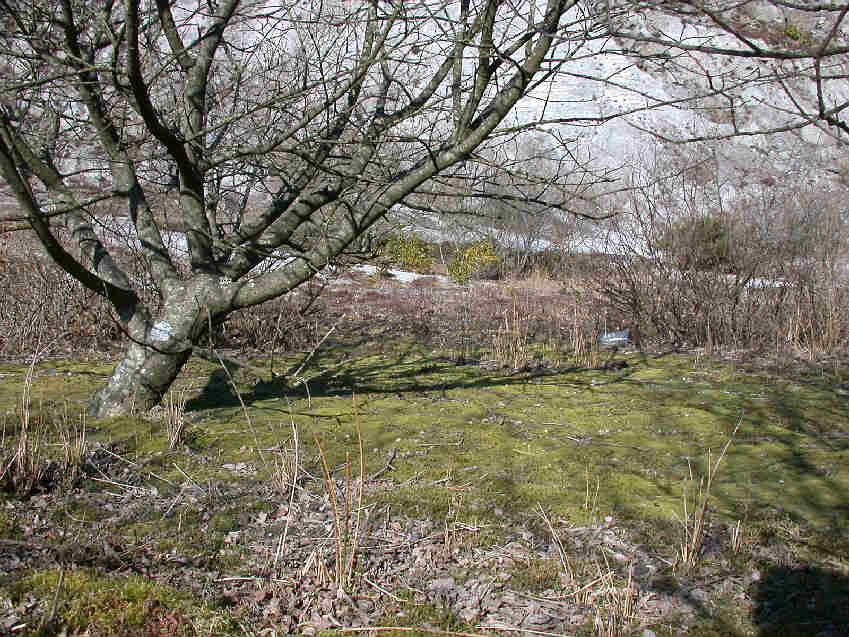
L. bispinosa blanketing the ground in floor of a china-clay pit. |
|||||