*1: Trefusis Grove,
Falmouth, 1841, EAW (TRU) (Paton 1969a:
700).
*2: Lostwithiel, 1906,
RWS (TRU) (Paton 1969a:
700).
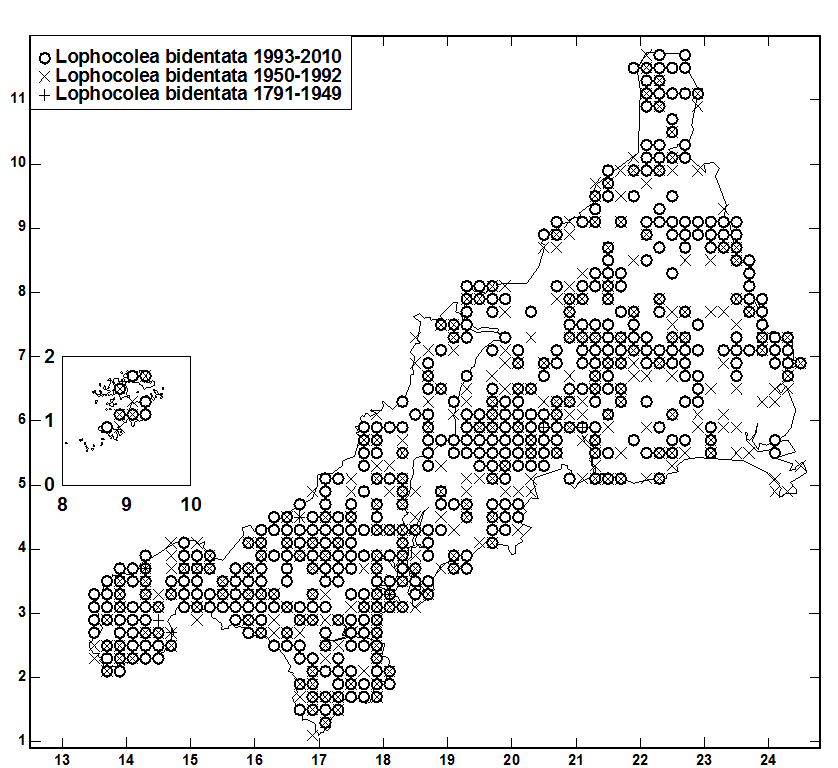
One of the commonest and most widespread liverworts
in Cornwall. Occurring in a wide
range of habitats: on soil, on or among mosses, on
ground-litter (dead leaves, twigs, bases of grasses), tree
bark (also Grey Willow bark), fallen trunks and branches
(including decorticated and decaying wood) or spreading over
sheltered rocks (granitic, gabbro, serpentinite, slates) and
masonry, in open or shaded. Occurs in wide range of habitats
including woodland (deciduous or coniferous), scrub, Grey
Willow carr, on laneside banks, shaded 'hedges', banks of
ditches, stream banks (sometimes in flood-zone), in flushes,
churchyards, on walls, in old quarries, on china-clay spoil,
in old mine-spoil areas, colonising disturbed soil, roadside
grass verges, slopes and banks high on cliffs and above
sea-cliffs where often partly sheltered but sometimes in
exposed situations (and then often
dwarfed).
Associates include many common mosses (commonly Brachythecium
rutabulum, Kindbergia praelonga,
Eurhynchium
striatum, Fissidens
bryoides var.
bryoides, Rhytidiadelphus
squarrosus, Thamnobryum
alopecurum, Trichostomum
brachydontium); often with Lophocolea
heterophylla on rotting wood; other associates recorded
include Brachythecium
rivulare, Calypogeia fissa, Cephalozia
bicuspidata, Cirriphyllum
piliferum, Lophocolea bispinosa,
Nowellia
curvifolia, Plagiothecium denticulatum
var.
denticulatum, Scleropodium
touretii.
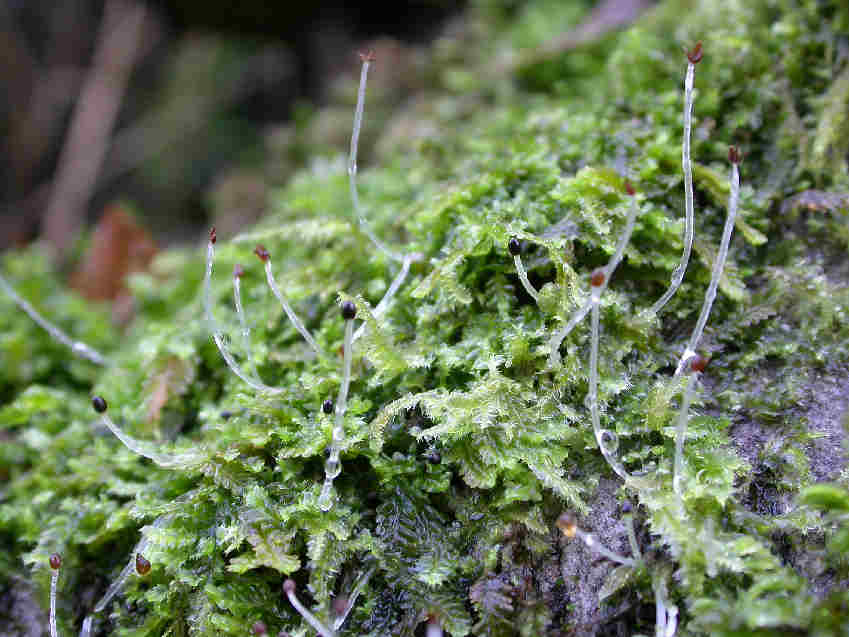
Perianths common: 3, 7, 8, 10-12. Frequently c.fr.:
immature 1-3, 11; dehiscing 1-4; dehisced 3, 4.